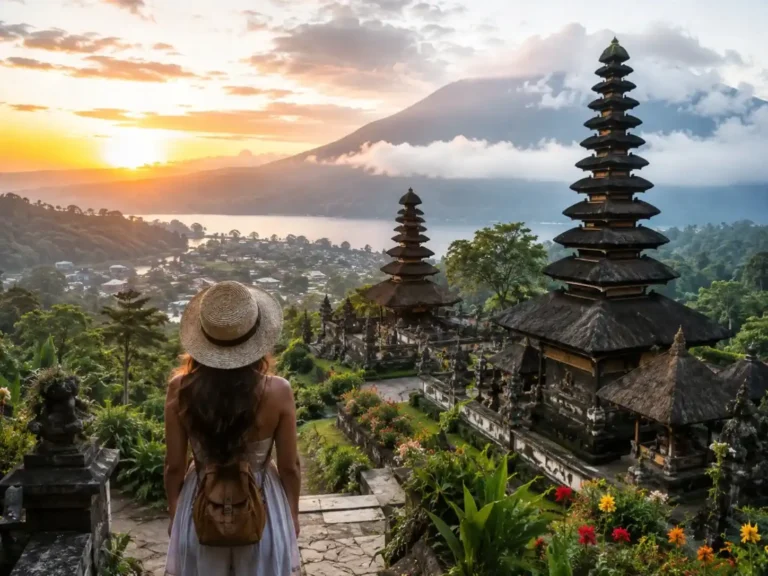
Sapa Trekking Guide 2026: Routes, Homestays, Costs & Best Time to Visit
I first landed in Hanoi with a rough plan and even rougher expectations of Sapa — the kind of trip where you’ve read fragments of half a dozen strangers’ stories and stitched together your own itinerary from the leftovers. Somewhere between a friend’s account of cycling in from China, a stint of housesitting in Northern Vietnam, and a damp February that nearly talked me out of the whole idea, I realized every trekker’s version of Sapa reads a little differently. I pulled threads from Nomadasaurus, Just Globetrotting, Novo-Monde, and Art of Active Travel — one writer’s 7-week trip dating back to 2014 and refreshed in November 2022, another’s quick detour before pushing on to Laos — and noticed how often the same beats repeated: the bleary overnight train, the rainy skies waiting on arrival, the last-minute scramble for waterproofing gear nobody quite budgeted time for.
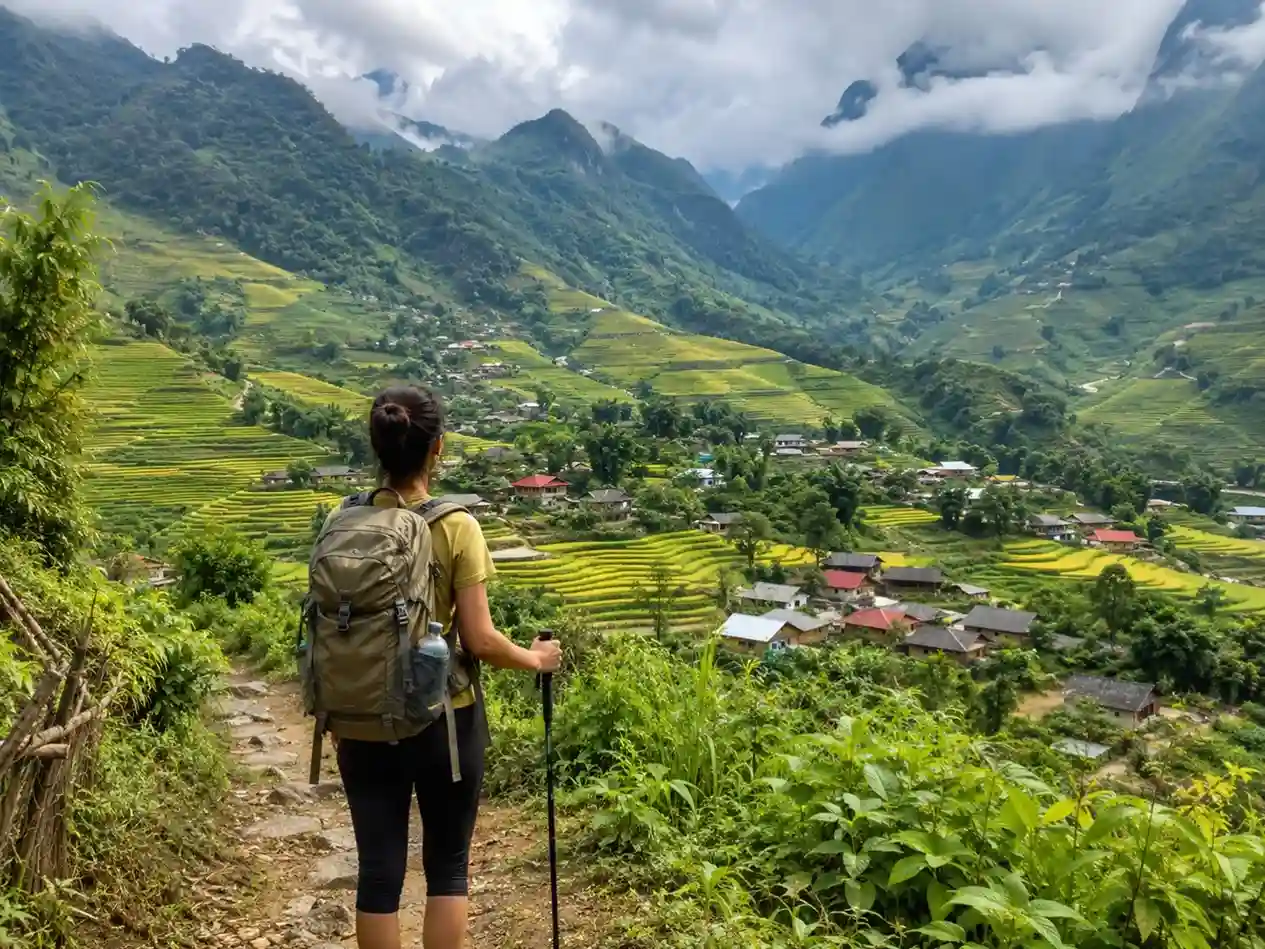
What ties all these accounts together, and what pulled me toward writing my own, is that Sapa isn’t really one experience — it’s a region in the far north of Southeast Asia built around the Muong Hoa Valley, where terraced rice fields climb the hillsides in a pattern photographs never quite do justice to. The seasonal color changes are dramatic: soft green during the planting season from May into June, deepening to gold through the harvest season across September and October, and for much of the rest of the year, wrapped in a misty landscape that rolls in without warning. Above it all sits Fansipan, at 3,143 m (10,312 ft), the highest peak in both Vietnam and Indochina — a fact repeated in every guide I read, and for good reason.
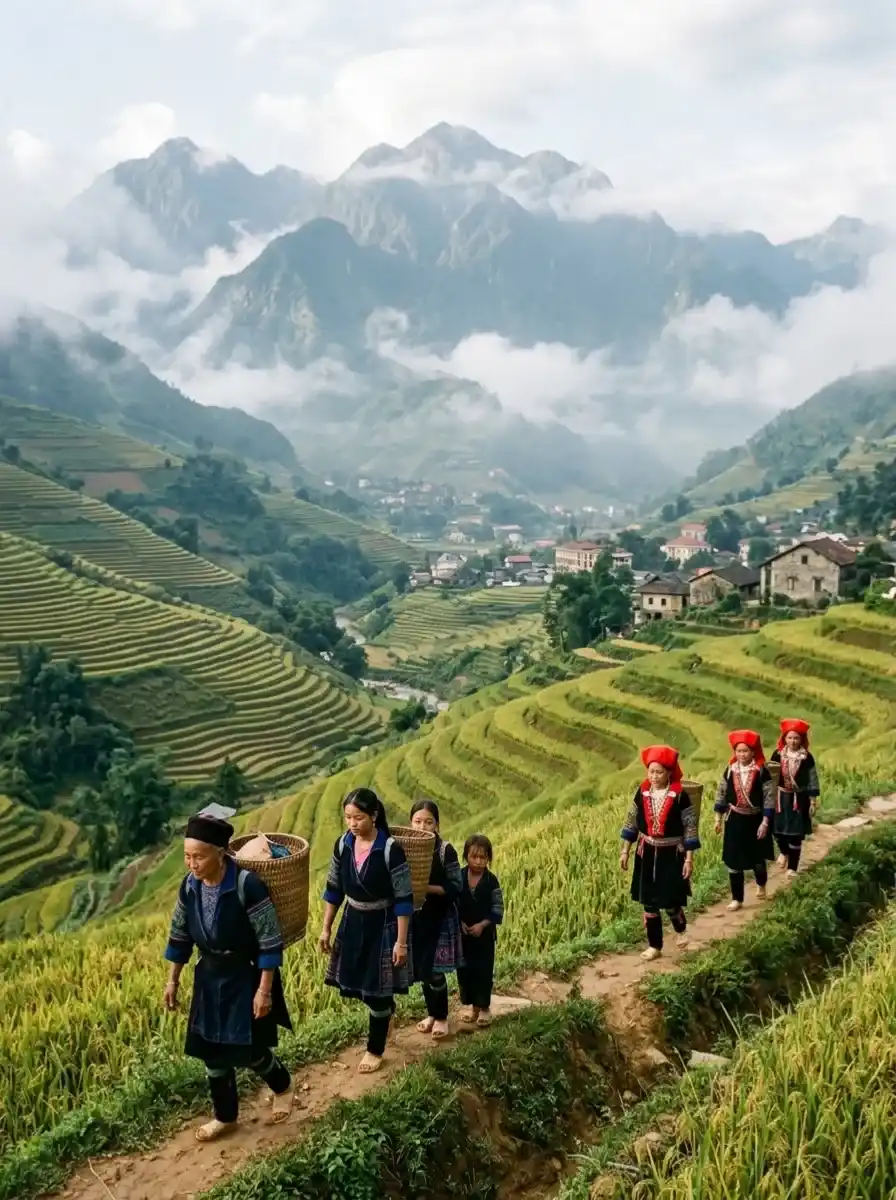
None of this scenery exists in isolation from the people who’ve shaped it. Sapa is home to several ethnic minority groups, with the Black Hmong making up roughly 52% of the district population, alongside the Red Dao, Tay, Giay, and Xa Pho communities. Sapa town itself sits at around 1,500 m in Lao Cai Province, some 340 km from Hanoi, and has only been open to organized tourism since 1993 — recent enough that plenty of older residents still remember what came before the guesthouses. This guide pulls apart the geography, the ethnic communities, the case for guided trekking versus self-guided trekking, the best trails, the local food culture, and the practical logistics across the seasons, with a nod throughout to the growing number of socially responsible trekking agencies doing right by the villages they walk through. Consider it my own first-timer’s guide — or, if you’ve already got a Sapa travel guide dog-eared from someone else, a second opinion worth reading before you book anything.
History & Culture of Sapa
Long before anyone called it a trekking destination, the mountain locals call Fan Si Pan — the same peak later romanized as Fansipan, at 3,143 m — watched over a Vietnam that had nothing to do with backpackers. Standing in Sapa on a clear morning, guide beside me, I found it strange to think this valley predates every hotel and homestay by millennia; the H’Mong, Dao, and Dai minorities who farm these slopes today trace roots here back far further than the town’s tourist-facing history suggests. The written record most guides lean on starts in the early 1900s, when French colonists began treating the area as a hill station — a cool mountain escape from the heat and noise of Hanoi below.
That colonial presence didn’t survive the century. By the 1940s, independence fighters had driven the French out, and French bombing during the retreat left much of the settlement in ruins. What followed was decades of quiet — no meaningful redevelopment, no tourism to speak of — until things slowly started moving again through the 1990s. It’s easy to miss, walking the valley trails today, that the story goes back much further than any of that: carved petroglyphs scattered through the Muong Hoa Valley are estimated at roughly 2,000 years old, older than the villages surrounding them now. The Black Hmong trace their arrival from southern China to around 3 centuries ago; the Red Dao migrated down from Hunan as early as the 13th century; and the Tay and Giay communities settled the valley floors even earlier, giving the region a genuine lowland presence layered beneath the hill-dwelling groups — what researchers sometimes call an altitude-stratified settlement pattern, each community occupying its own elevation band.
The French colonial chapter, brief as it was, left a heavier mark than its short run suggests. French surveys of the area began in 1898; a military garrison followed in 1903; a formal settlement plan was in place by 1909, and through the 1920s the town filled out with colonial villas, a church, and a small hotel. The Stone Church of Sa Pa, completed in 1930, is still the most recognizable relic of that era. The French also built the Hanoi–Lao Cai railway between 1901–1906, using Vietnamese laborers under conditions grim enough that few guides mention them by name. None of it lasted. The First Indochina War, from 1946–1954, flattened most of what had been built, leaving Sapa an abandoned town for years. Tensions flared again during the brief Sino-Vietnamese War in 1979, close enough to the Lao Cai border that fighting reached the region directly.
International tourism only properly resumed from 1993 onward, and the numbers since tell their own story: visitor numbers sat around 5,000 in 1995, then climbed past 2 million by 2022 — a staggering curve for a town this size. That growth shows in the poverty rate, still hovering near 28% among the largely ethnic-minority population, sitting uncomfortably alongside the glass-fronted hotel towers now crowding the skyline above the rice terraces.
Getting to Sapa (Train vs. Bus)
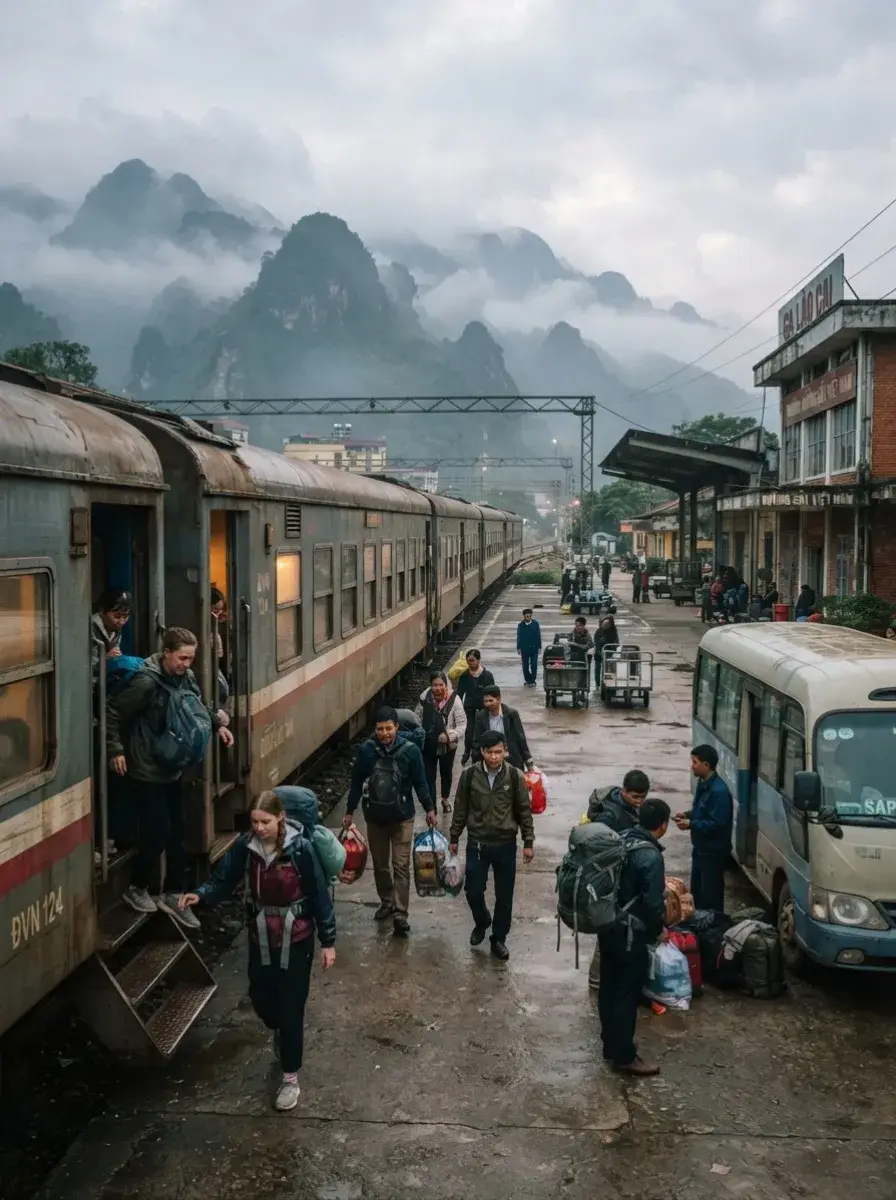
Getting yourself from Hanoi to Sapa is its own small adventure, and I’ll admit I overthought it before landing on a plan. My first move was walking into a travel agent near the Old Quarter, and within a day I had a motorbike pickup arranged to the station for an overnight train — the kind of ride where the pop music blaring through the carriage speakers wakes you up whether you like it or not, right as you’re pulling into Lao Cai. Other travelers I met on the trail had gone the sleeper bus route instead, and swapped stories about the track rattle on the train versus the jolting of a bus seat that doesn’t quite recline. Either way, you’re looking at roughly 9 hrs door to door once you factor in the 1-hr minibus connection at the other end.
There’s no shortage of ways to book this yourself, whether from the Hanoi Old Quarter in person or online through something like Bookaway or a plain Google search. Pricing varies more than you’d expect: the train runs close to $42 USD, while a bus ticket can be had for $10–15 USD. One newer operator, Chapa Express, gets singled out often for genuinely flat beds and working power outlets — worth the upgrade if you’re prone to a stiff back. I’d skip the VIP train cabin though; paying an extra $85 mostly buys you a 2-bed cabin instead of sharing a 4-bed one, plus a few snacks that don’t justify the markup. If you’re traveling in high season, book ahead, especially for Sunday returns — tickets through Vietnam Railways or any bus ticket booking site sell out fast.
Not everyone starts from Hanoi, either. I met a couple who’d come down from Ba Be by bus, trading stories about a genuinely reckless driver and a rough case of travel sickness somewhere along the mountain switchbacks. Bus fares on that route run 264,500–504,000 VND, while train tickets start around 679,000 VND for a 4-berth cabin, typically departing 10pm and rolling in around 6am. If you’re coming via Thai Nguyen instead, budget about 420,000 VND for the connection, or consider it by motorbike if you don’t mind covering 350 km yourself. Whichever way you arrive, remember you’ll actually be dropped in Lao Cai, not Sapa itself — the yellow and red minibuses waiting there run the last stretch for about 30,000 VND, operating roughly 5:20am–5pm.
Since Sapa has no airport, most international arrivals route through Noi Bai in Hanoi, about 340 km away. From there, it’s either the overnight sleeper train (8–9 hrs including the 45–60 min transfer bus) or a direct overnight sleeper bus (5–6 hrs, no changeover required). Day buses run too, for anyone who’d rather not sleep sitting up. Once you’re actually in the valley, a motorbike taxi — locally called xe om — will get you between trailheads for around 50,000–100,000 VND, or you can arrange private vehicle hire through your hotel. Grab and regular taxi services also work well for reaching somewhere like the Tram Ton Pass trailhead, usually costing 150,000–200,000 VND each way.
Choosing a Trekking Company / Guide
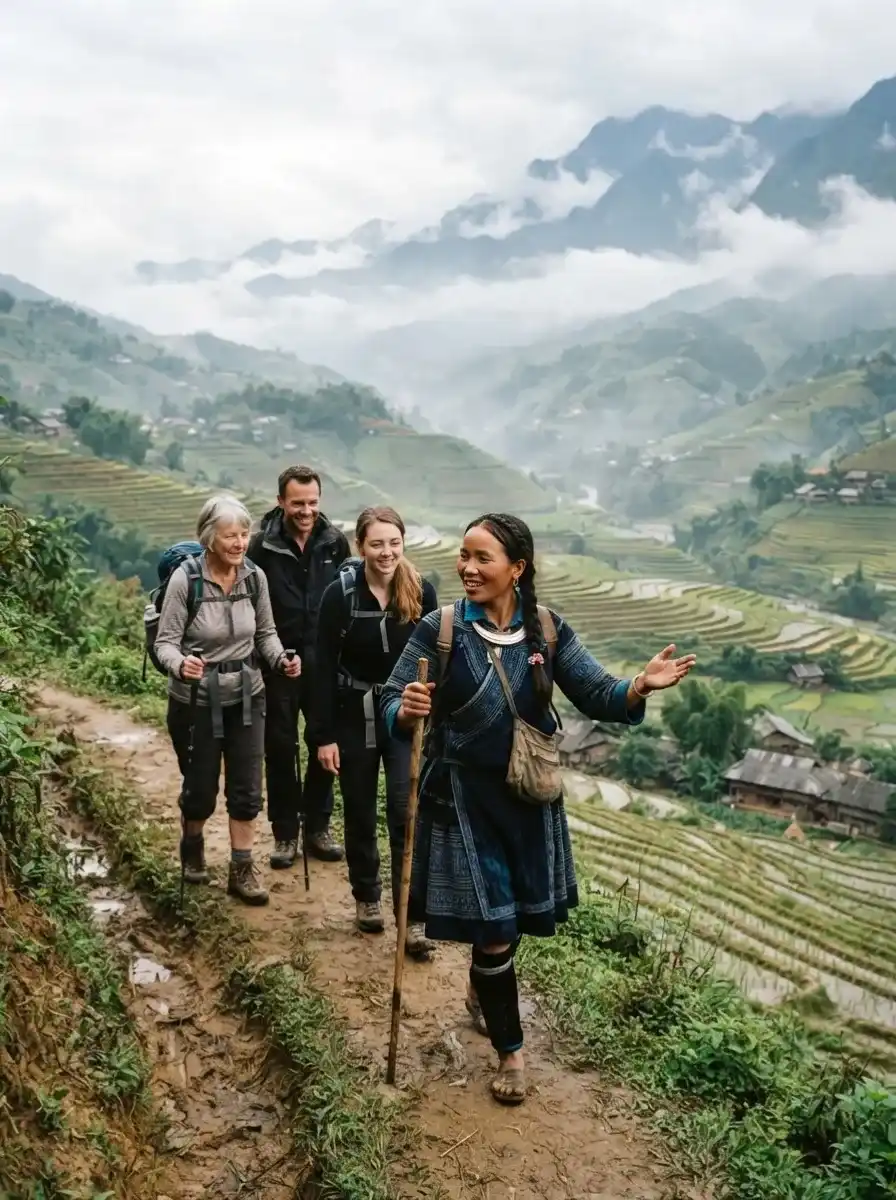
Picking who actually leads you through the valley matters more than most first-timers realize. I ended up comparing a handful of operators before settling on one, starting with Lily’s Travel Agency at 16 Ngo Huyen in Hanoi, though plenty of people book equally well through something like GetYourGuide. One thing worth flagging: booking through your hotel usually means eating a hotel commission baked into the price, so it pays to shop around directly. The name that came up again and again in conversation with other trekkers was Sapa Sisters, an all-female Hmong guiding company operating out of the Muong Hoa Valley, staffed by genuinely English-speaking guides with a clear social mission behind the business, distinct from the classic tours run by generic city agencies with rotating Hmong guides on the payroll.
There’s also a real ethical dimension here that goes beyond comfort or price. Operators like Ethos and Sapa O’Chau fall under a growing bracket of socially-conscious agencies, and after hearing about the pricing inconsistency some travelers ran into with cheaper street-booked tours, I understood why. Self-guided trekking is technically possible too, especially if you’ve already got homestays lined up and something like the Ethos map to navigate by — it comes down to an ethical choice as much as an economic choice. Local guides, and specifically ethnic-minority guides, will point out things you’d otherwise walk straight past: petroglyphs half-buried in undergrowth, seasonal farming context for whatever’s growing in the terraces that week, introductions to homestay families rather than a stranger’s front door, and confident navigation of unmarked paths that would leave most visitors turned around within the hour.
For anyone attempting the Fansipan ascent, hiring a guide isn’t optional — it’s legally mandatory under Hoang Lien National Park rules. The two names worth remembering are Sapa O’Chau, a genuinely Hmong-run social enterprise built around education reinvestment, and Sapa Sisters, a women-owned agency that places guests directly in guides’ own family homes rather than generic guesthouses. If you do go the independent route, offline maps through Google Maps, Maps.me, or Gaia GPS cover the main routes reasonably well, though the bamboo forest sections get genuinely disorienting in poor rain conditions. What a guide really buys you, more than safety, is status as a cultural guest rather than a passer-through. And one firm rule regardless of who you book with: don’t encourage children selling crafts on the trail — buy instead from adult women artisans at village markets or community shops, where the money actually lands where it should.
Accommodation (Homestay vs. Hotel)
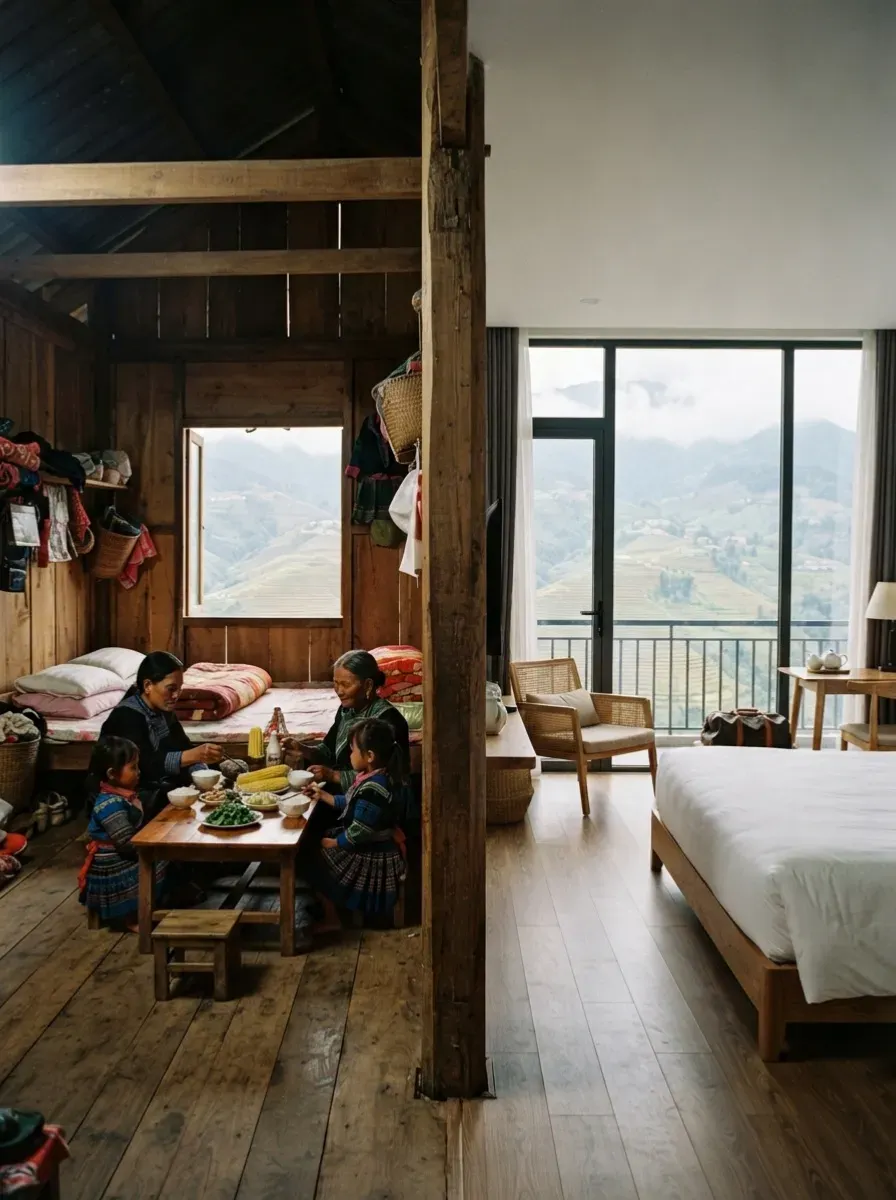
Deciding where to actually sleep splits opinion fast. Sapa town itself is thick with what one blogger rightly called a tourist trap guesthouse scene, but the alternative — a proper homestay — comes with its own trade-offs worth knowing upfront: you don’t get a food choice, you don’t pick your roommates, and you’re at the mercy of whatever your tour operator arranges unless you specifically request a private stay. For anyone who’d rather keep things simple, Hostelworld covers the town-based options fine.
My own homestay turned out to be more of a family-run guesthouse sleeping close to 20 people than the intimate one-family setup the brochure implied — but honestly, a night of games, dancing, and shared drinking with strangers turned friends more than made up for the lack of intimacy. If hotels are more your speed, Sapa town has plenty: rooms with a private bath run as low as $6–8, and if you want actual rice-field-view rooms, head slightly out toward Va Tan for roughly $10/night — my own stay at the Mimosa Hotel landed right in that range after a bit of bargaining at the front desk, which is standard practice locally.
The town has been through a genuine hotel construction boom in recent years, and the strip along Fansipan Street and Muong Hoa Street now has the highest density of it. Mid-range hotels run $20–50/night, while the newer resort-style properties push past $200+ a night for valley views. If you’re visiting between November–March, confirm heating before booking — it matters more than you’d think at altitude. Out in the villages, a Hmong family homestay or Giay family homestay is the real draw, though standards vary: some now have flush toilets and warm showers, others don’t, and community-based operators like Sapa O’Chau and Sapa Sisters are worth booking through specifically because they vet these standards, typically charging $15–35/person including dinner and breakfast.
For the more serious among you attempting Fansipan, the Fansipan mountain camps at roughly 2,800 m are about as basic as accommodation gets — a bunk or sleeping mat, a blanket, and a camp cook preparing hot food after dark. Every one of the licensed operators running the two-day summit route bundles this into the price, so there’s nothing extra to arrange yourself.
Cost of Trekking in Sapa
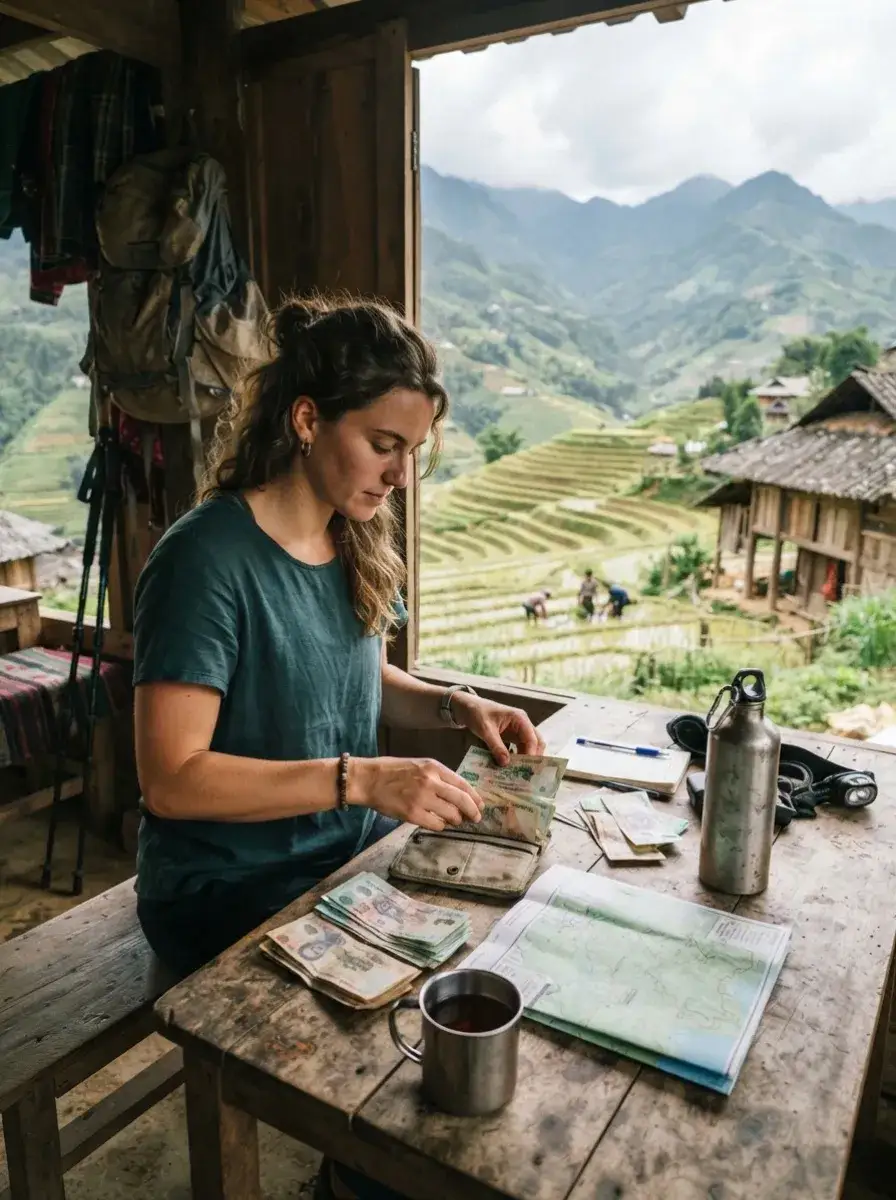
Budgeting for Sapa is straightforward once you know the ranges. A standard 3-day/2-night tour runs roughly $65–$117 USD depending on whether you take the sleeper bus or sleeper train each way, and most packages come with meals included — typically 3 breakfasts, 3 lunches, and 2 dinners, plus more rice wine than you’ll know what to do with. Drinks are the one place costs creep up: coffee runs about 20,000 VND, beer around 30,000 VND, and bottled water (1.5L) another 20,000 VND — I tracked my own drink spend at close to 250,000 VND, roughly $10, over three days. Tipping isn’t expected, though it’s welcomed, and don’t be surprised if you’re offered handmade goods at every meal stop along the way.
On currency logistics: Sapa runs on VND currency, with ATMs in town and cards accepted at the bigger hotels — but you’ll want cash on hand for homestays, guide fees, entrance tickets, and motorbike taxis, none of which take plastic. A reasonable daily budget excluding accommodation sits around 200,000–500,000 VND ($8–20). A guided full-day trek runs 350,000–1,000,000 VND ($15–40) depending on group size and operator, while a full 2-day Fansipan trek climbs to roughly $135–145 USD per person. If you’d rather skip the climb entirely, the cable car costs about 800,000 VND ($32) return, and the Cat Cat Village entry fee for a simple half-day trip runs about 70,000 VND.
Best Time to Visit Sapa (Season)
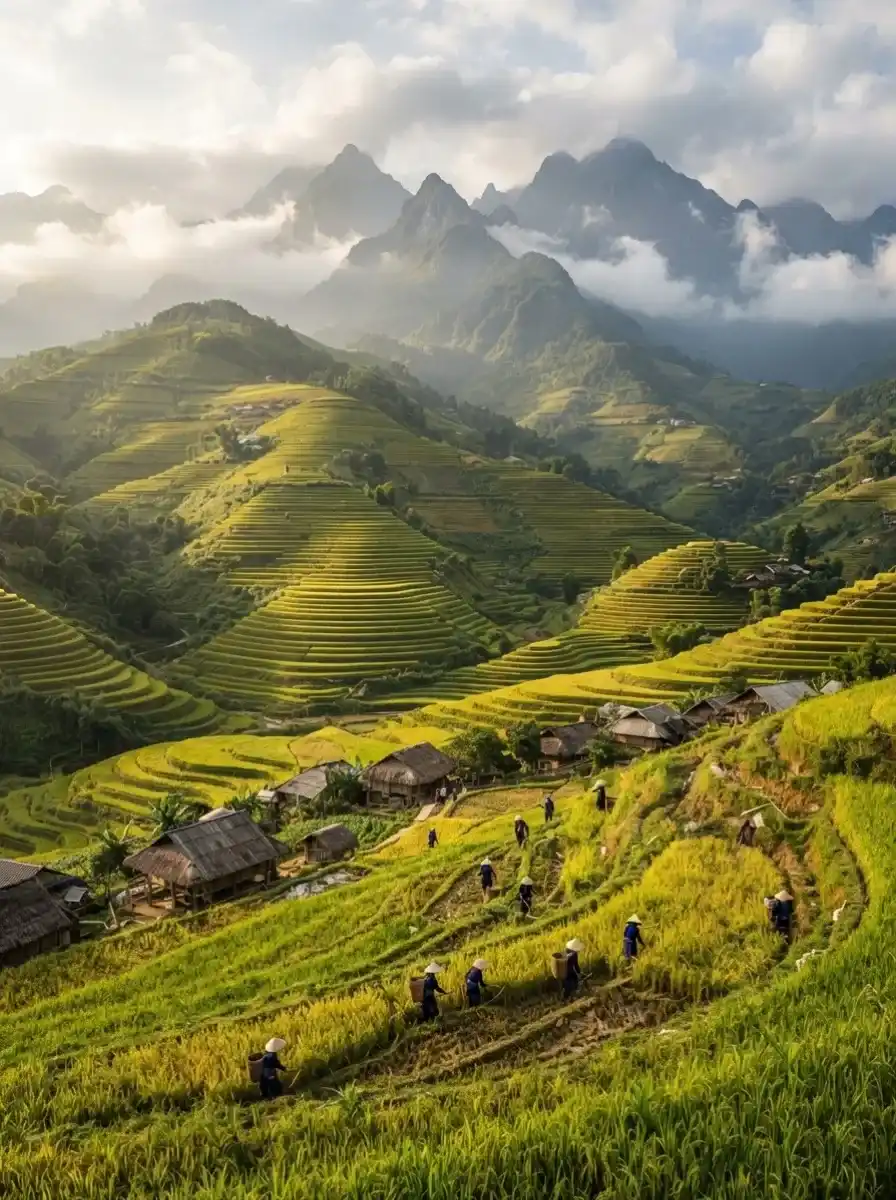
Timing your trip changes the entire experience, and I’ve now seen Sapa in more than one season to say that with confidence. Winter, roughly December–March, brings heavy fog that can sit over the valley for days; summer trades that for more clear days overall. Broken down more precisely: March–May is the dry season, while June–September shifts into the rainy season, with the rice harvest landing around September, when the green-to-gold fields put on the show most photographers are chasing.
That September–October harvest window is genuinely the best stretch for gold terraces and comfortable daytime temperatures around 15–20°C, helped along by the post-monsoon visibility that clears the air after the wet months — just be aware that homestay booking gets competitive then. Spring planting, running through the same March–May window, gives you flooded paddies instead, with a near mirror-like reflection across the water and wildflowers starting to appear higher up the mountain, along with fewer crowds than autumn brings. Watch for early March cold though — nighttime temperatures can drop to 5°C in town, with genuinely freezing temperatures up at the Fansipan summit.
November–February winter is the moodiest stretch, cloud-bound for long periods with daytime highs of 5–12°C and sub-zero altitude conditions higher up; snow occasionally reaches Fansipan and, rarely, the town itself. Muddier trails are common through this period, though it’s also the least crowded time to visit if solitude matters more to you than clear views. Steer clear of the June–August monsoon if you can help it — heavy rain and thick humidity push daytime temperatures near 25°C, and the resulting slippery clay trails can turn into genuinely impassable trail sections on the steeper routes. The upside, if there is one, is a properly lush green landscape that photographs beautifully even in the rain.
How Many Nights Should You Stay?
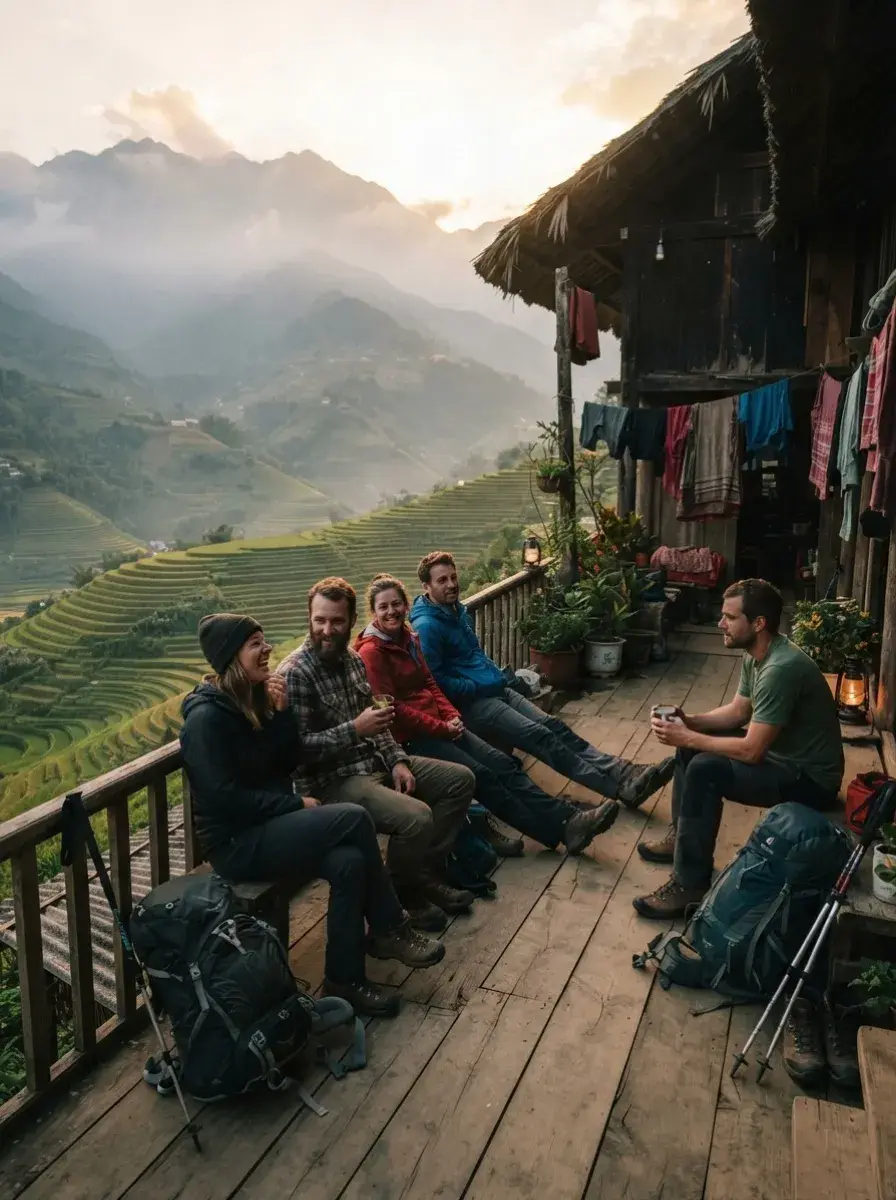
Most common tours are built around a 1–2 nights homestay structure, and honestly, that’s about right for most people. Push for a 3rd night and you might find your tour leaders genuinely unsure what to do with you — the standard itinerary just isn’t built for it. In my own experience, the 2nd day consistently beat the first: more dramatic views, a route that felt noticeably less touristy, and a smaller homestay group of just 5 people instead of the 15 people we’d started with. By day 3, though, I was more than ready to rejoin civilisation.
What to Pack for Trekking in Sapa

Packing for Sapa comes down to one rule: whatever you bring, you carry. I traveled with a day pack for daily essentials and a smaller bag for evening items, leaving big luggage behind in Hanoi entirely. A lightweight rain jacket is easy enough to pick up last-minute in the Sapa market — plenty of knockoff brands sell there for around 100,000–300,000 VND — and if you’re trekking through the cold months, a proper winter jacket is worth sourcing the same way. Don’t skip earplugs; between noisy roommates and the inevitable rice wine nights at the homestay, you’ll want them. Round out the basics with extra shorts, spare t-shirts, sunscreen (the high-altitude UV is stronger than it looks even under cloud), bug spray, and bandaids for the blisters that catch almost everyone by day two.
Footwear matters more here than most people expect. Real hiking shoes with decent grip beat trainers every time once the mud starts and the slipping begins on the terrace paths. Beyond that: hand sanitizer, toilet paper, a proper waterproof jacket or poncho, and a small umbrella if you’re traveling through the rainy season. Pack spare socks and underwear generously, plus flip-flops for after the shower, pyjamas or other sleepwear, and if you don’t own hiking boots, wellies are rentable through operators like Sapa Sisters. Round out the kit with a water bottle and a camera — you’ll want both constantly.
For longer day treks specifically, waterproof hiking boots or trail shoes with good grip, an insulating layer for cooler mornings, at least 2L water, cash, and a phone loaded with offline maps cover the essentials. Anyone tackling Fansipan ascent gear needs a proper waterproof shell, an insulating mid-layer, a fleece, a warm hat, gloves, a headtorch, and trekking poles — plus enough food supplies if you’re attempting a one-day push rather than the two-day version. Your guide typically carries emergency gear and cooking gear on multi-day routes, which helps, but don’t count on any mobile phone signal once you’re above the valley floor.
Geography of Hiking in Sapa
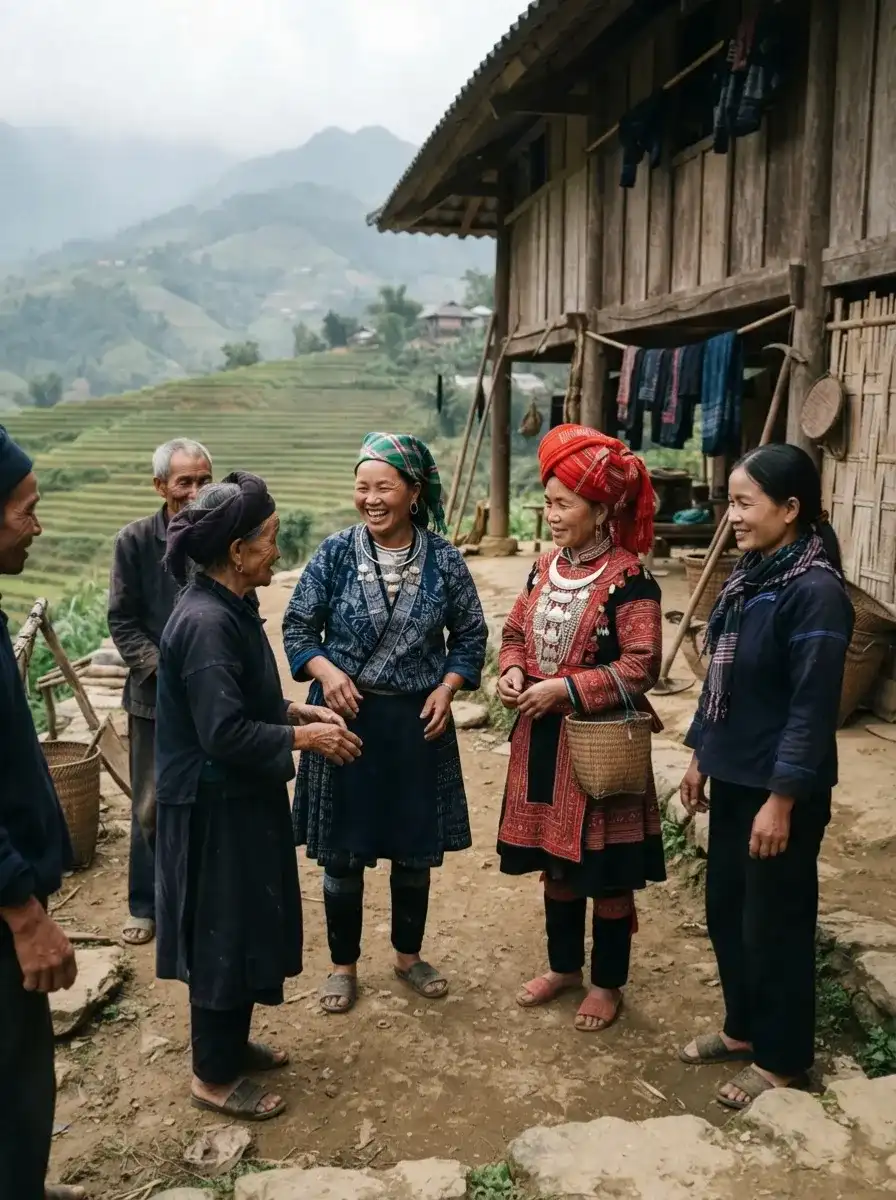
The physical shape of Sapa district, tucked into Lao Cai Province, is worth understanding before you set foot on a trail. It sits within the Hoang Lien Son range, technically an eastern Himalayan extension, dominated by Fansipan at 3,143 m — the highest point in the whole system, flanked by neighboring summits Pu Luong (2,985 m) and Tay Con Linh (2,419 m). The Muong Hoa Valley, stretching roughly 15 km to the southeast of Sapa town, is the main trekking corridor most visitors walk, following the course of the Muong Hoa Stream through a string of villages — Y Linh Ho, Lao Chai, Ta Van, and Giang Ta Chai — each with its own character.
Beyond the valley floor, the terrain shifts fast. Hoang Lien National Park covers roughly 29,845 hectares and moves through distinct forest zones: subtropical broadleaf below 1,800 m, temperate montane forest up to 2,600 m, and finally open subalpine scrub above that. The Tram Ton Pass, also known as O Quy Ho Pass, crosses the range at around 1,900 m and holds the title of the highest mountain road pass in the country — it’s also the starting point for the main Fansipan trekking route. Nearby, the Silver Waterfall drops roughly 200 m and makes an easy stop for anyone driving through.
One detail I wish more people knew before walking the valley: the Muong Hoa Valley petroglyphs, a scatter of roughly 200 carved stones spread across about 8 sq km, are estimated at nearly 2,000 years old and have sat on Vietnam’s UNESCO Tentative List since 1997 — genuinely ancient markings hiding in plain sight along a trail most people walk straight past without noticing.
The Ethnic Minorities of Sapa
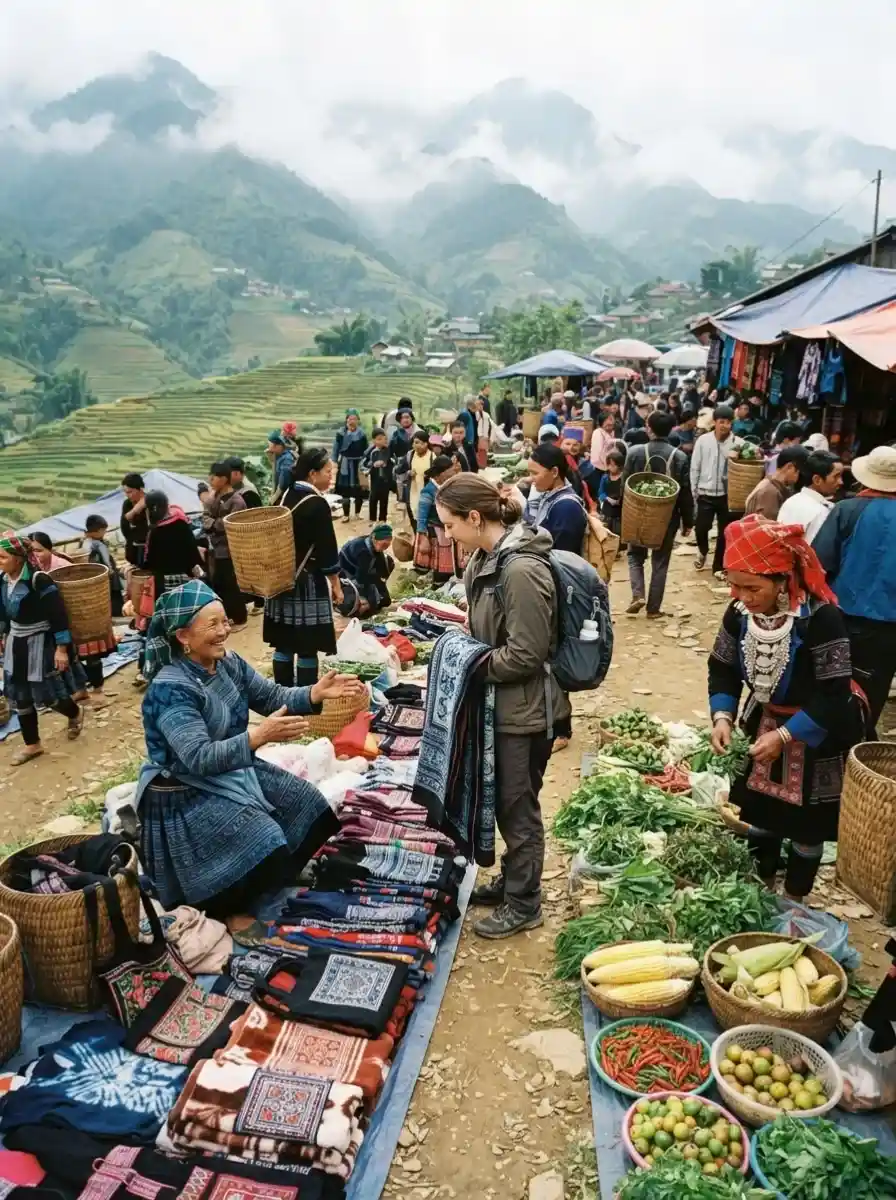
Understanding the communities you’re walking through changes the whole trip. The Black Hmong, at roughly 52% of the district population, are the group you’ll meet most, easily recognized by their indigo-dyed hemp clothing. Their society runs on a patrilineal clan society structure, and daily life is threaded with animist practice and ancestor veneration — most homes keep household altars you shouldn’t approach uninvited. Older residents still talk about the historic love market tradition, largely faded now but once a genuine social institution.
The Red Dao are the second-largest group in the region, unmistakable by their red headdresses and heavily embroidered clothing; the best place to meet them is Ta Phin village, about 12 km from Sapa town. Red Dao women carry deep herbal medicine knowledge, passed down through generations, and it’s this expertise behind the region’s well-known herbal bath tradition.
Further along the valley, the Tay are traditionally valley-floor wet-rice farmers, culturally closer to lowland Vietnamese than the hill-dwelling groups. The Giay, part of the broader Tai-Kadai language group, are concentrated around Ta Van village. And the Xa Pho, a genuinely small population of under 10,000, live in higher forest settlements rarely touched by tourism — their fine cotton textile work is arguably some of the best craft in the region, though you’ll almost never see it on standard routes.
Other Activities in Sapa
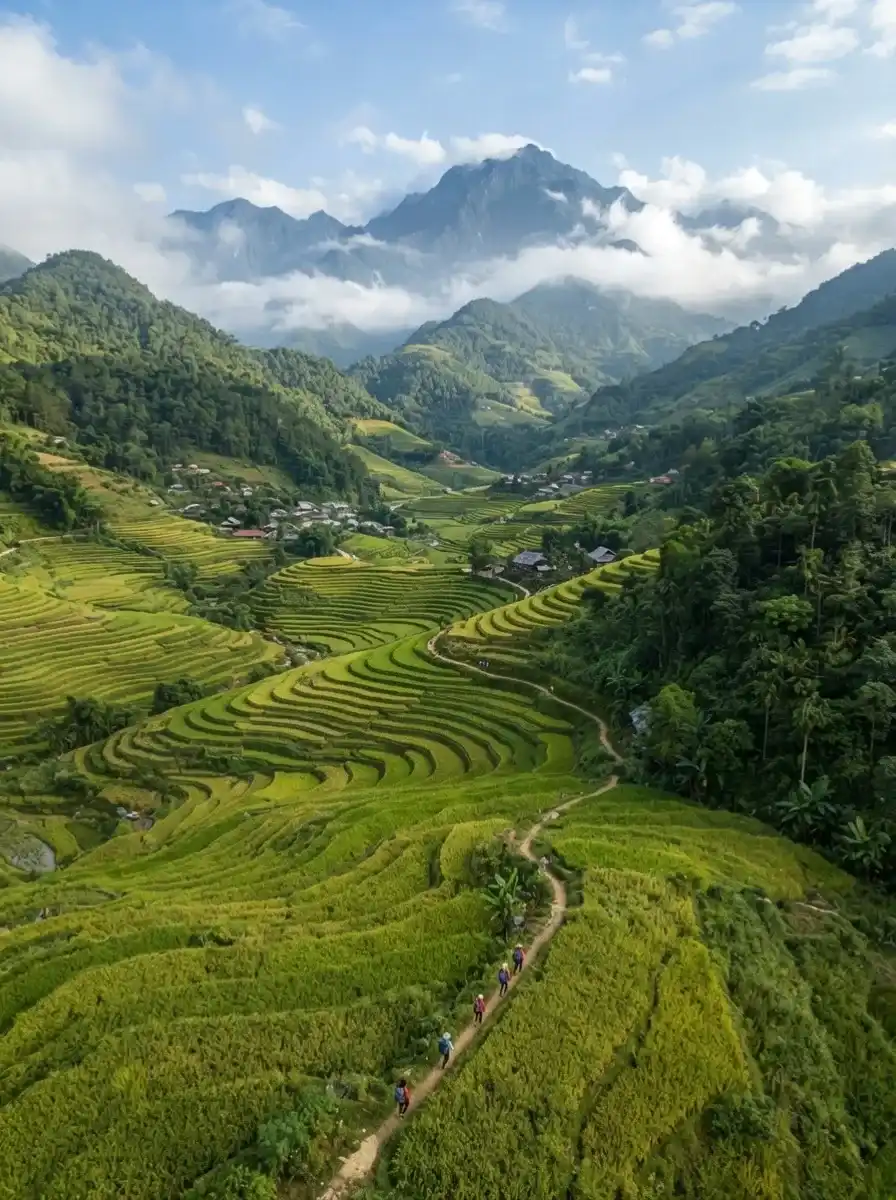
If a full day on the trail isn’t for you, there’s still plenty to do without committing to a serious trek. A short walk through Ta Van and the wider Muong Hoa Valley takes in several villages without demanding much stamina. Sapa’s rotating minority markets are worth building a day around too — Coc Ly runs Tuesday, about 2 hrs east of town; Can Cau falls on Saturday, roughly 3 hrs northeast; Bac Ha, held Sunday, is the largest market in the region; and Muong Hum, also a Sunday affair, sits 2 hrs north.
Fansipan climbing is the other big draw, and you’ve got two real options. The multi-day trek version runs about $63–70/person for a one-day guided version with two people sharing the cost, or you can skip the effort entirely with the cable car — a 15-min ride for 700,000 VND ($28) that still leaves you with 600 steps or a funicular ride to reach the true summit. I’ll admit the whole setup earns its Disneyland comparison, but the view from the top on a clear day makes up for it.
For something lower-effort still, the O Quy Ho Pass — also called the Tram Ton Pass viewpoint — sits about 15 km from Sapa center and makes a genuinely worthwhile alternative viewpoint if Fansipan feels like too much.
Best Trails for Hiking in Sapa
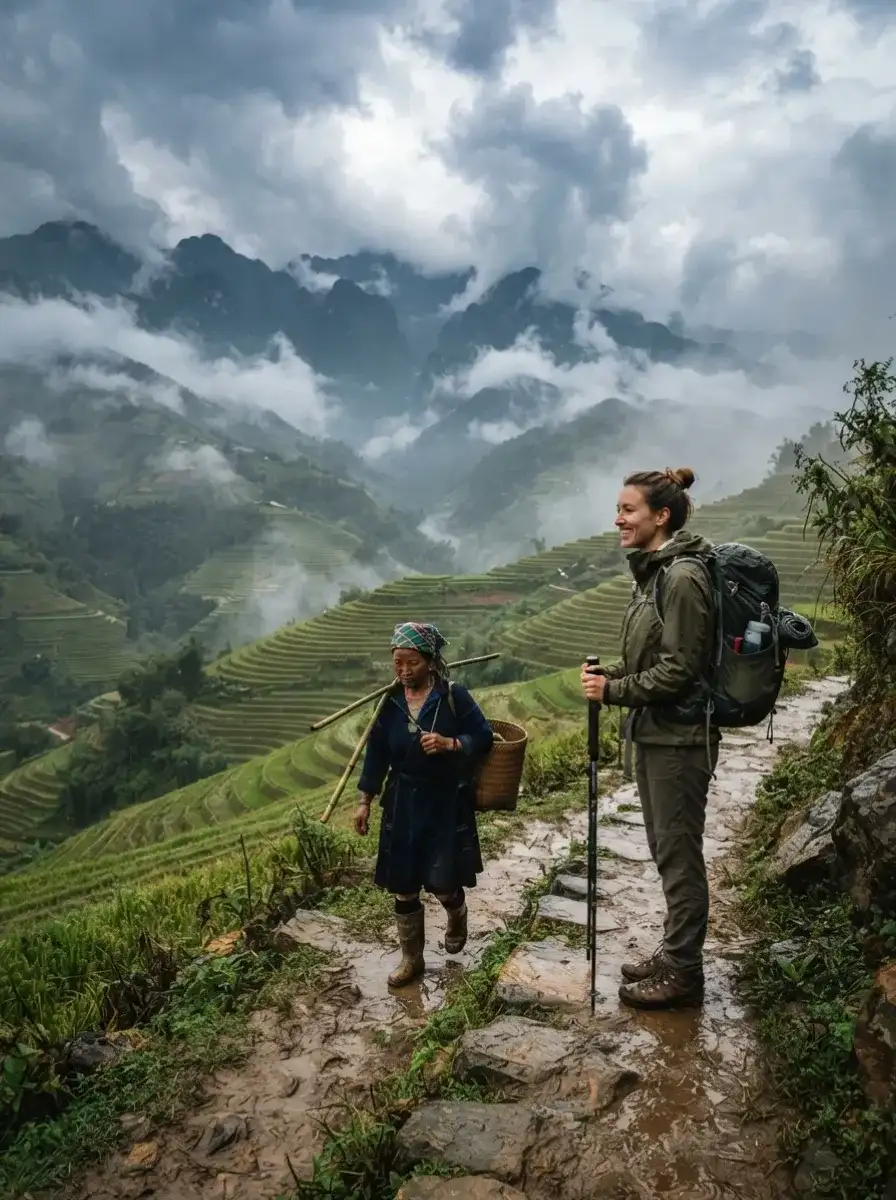
The Muong Hoa Valley classic route is the trail most people mean when they say they’ve trekked Sapa: 10–14 km, roughly 5–7 hrs of walking, rated moderate difficulty, with about 656 m elevation change across the day. It runs through Cat Cat, Y Linh Ho, Lao Chai, Ta Van, and Giang Ta Chai, passing the valley’s carved petroglyphs, a photogenic suspension bridge, and a small waterfall before most groups arrange a motorbike taxi return to town.
If you’re short on time, Cat Cat Village covers a modest 4 km round trip in about 2–3 hrs, rated easy-moderate, with a 70,000 VND entry fee. It’s the most accessible village from town, though also the most commercial village — go early morning or late afternoon if you want it without the crowds. Ta Phin Village, by contrast, sits about 12 km out, with an 18–20 km full loop taking 4–6 hrs; it’s proper Red Dao territory, complete with an old French-built cave along the route and, at the end, a genuine herbal bath experience worth the extra distance.
Then there’s Mount Fansipan itself — the 3,143 m summit, reached from the Tram Ton trailhead at 1,900 m, covering 11.2 km one-way. A 1-day fast ascent takes about 7–8 hrs, usually finishing with a cable car descent; the 2-day version breaks it up with a night at a mountain camp around 2,800 m. A guide mandatory rule applies either way. If walking up isn’t the point for you, the cable car itself is remarkable — 6.3 km covering 1,410 m elevation in just 15 min, a genuine Guinness World Record holder for the greatest elevation gain on a non-stop 3-rope cable car.
Worth building a whole day around separately: the Bac Ha Sunday Market, about 70 km away (2.5 hrs drive), draws the Flower Hmong subgroup, instantly identifiable by their multicolour embroidery, a striking contrast to the Black Hmong indigo you’ll see everywhere else. It’s a full day trip in its own right, but a genuinely worthwhile add-on if your schedule allows it.
Food and Drink in Sapa
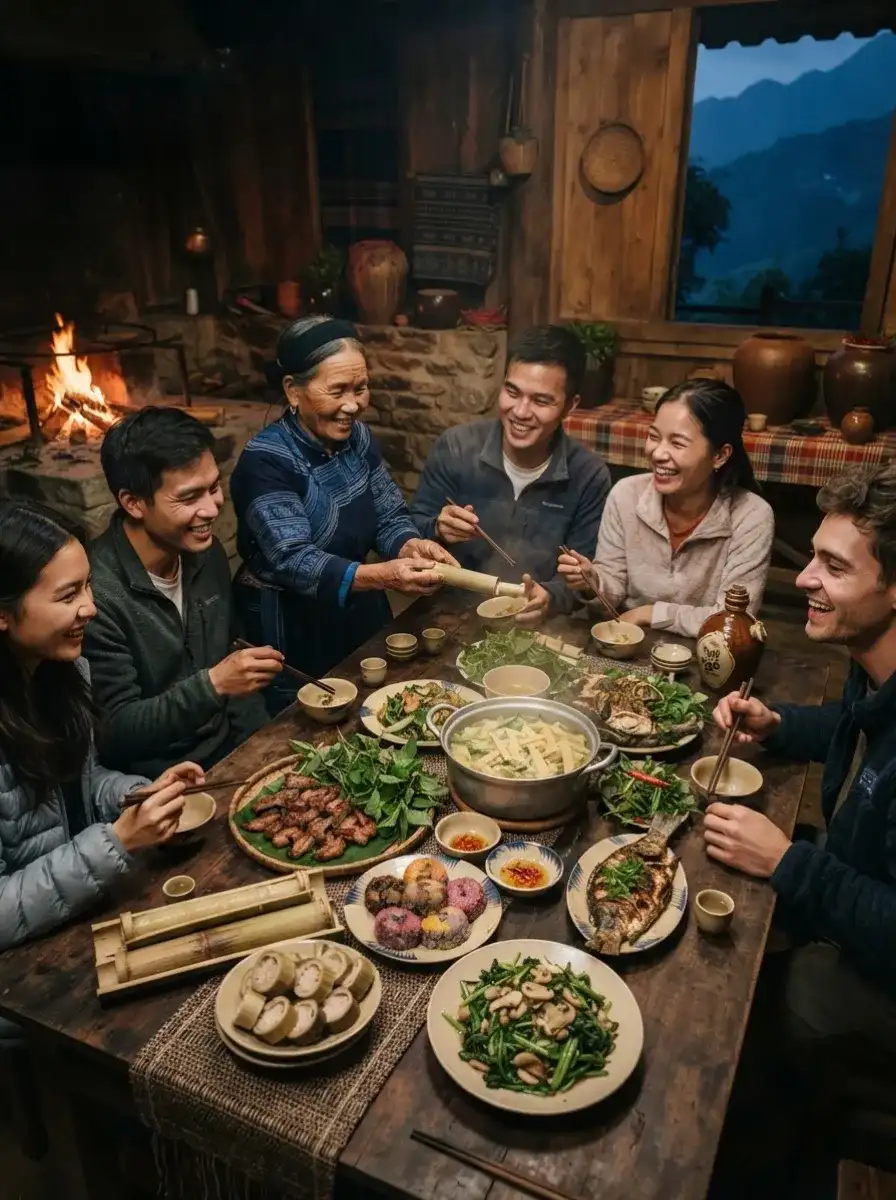
Food in Sapa deserves as much attention as the trails. Thang co, the region’s Hmong signature dish, is built from horse meat or buffalo meat, along with bones and offal, simmered for hours with up to 20 mountain herbs and spices — it’s an acquired taste, but pair it with corn wine (locally, ruou nguo) and it starts to make sense. Com lam, or bamboo tube sticky rice, is easier on newcomers: charcoal roasted and endlessly portable, it’s essentially the region’s default portable trail food. At homestay dinners you’ll also meet men men, a dried corn meal porridge that functions as an everyday Hmong staple, and xoi ngu sac, the Tay five-colour sticky rice, naturally dyed and served as both festival food and street food in Sapa market.
For meat lovers, cap nach pig — a free-range black pig, grilled over charcoal — gets called the best pork northern Vietnam has to offer, and I won’t argue. Drinks-wise, that same ruou nguo welcome drink shows up at nearly every homestay table, while ruou tao meo, a mountain apple wine, offers something milder for anyone pacing themselves. When you need a proper morning reset, Vietnamese filter coffee — ca phe den — served the traditional way, does the job better than anything imported.
One more thing worth building into your itinerary: the Red Dao herbal bath. A proper wooden barrel soak in forest-herb-infused water claims real benefits for muscle recovery, circulation, and general skin benefits — arrange it directly at Ta Phin or through a trusted community operator for the most authentic version.
Our 6 Commandments to Enjoy Sapa
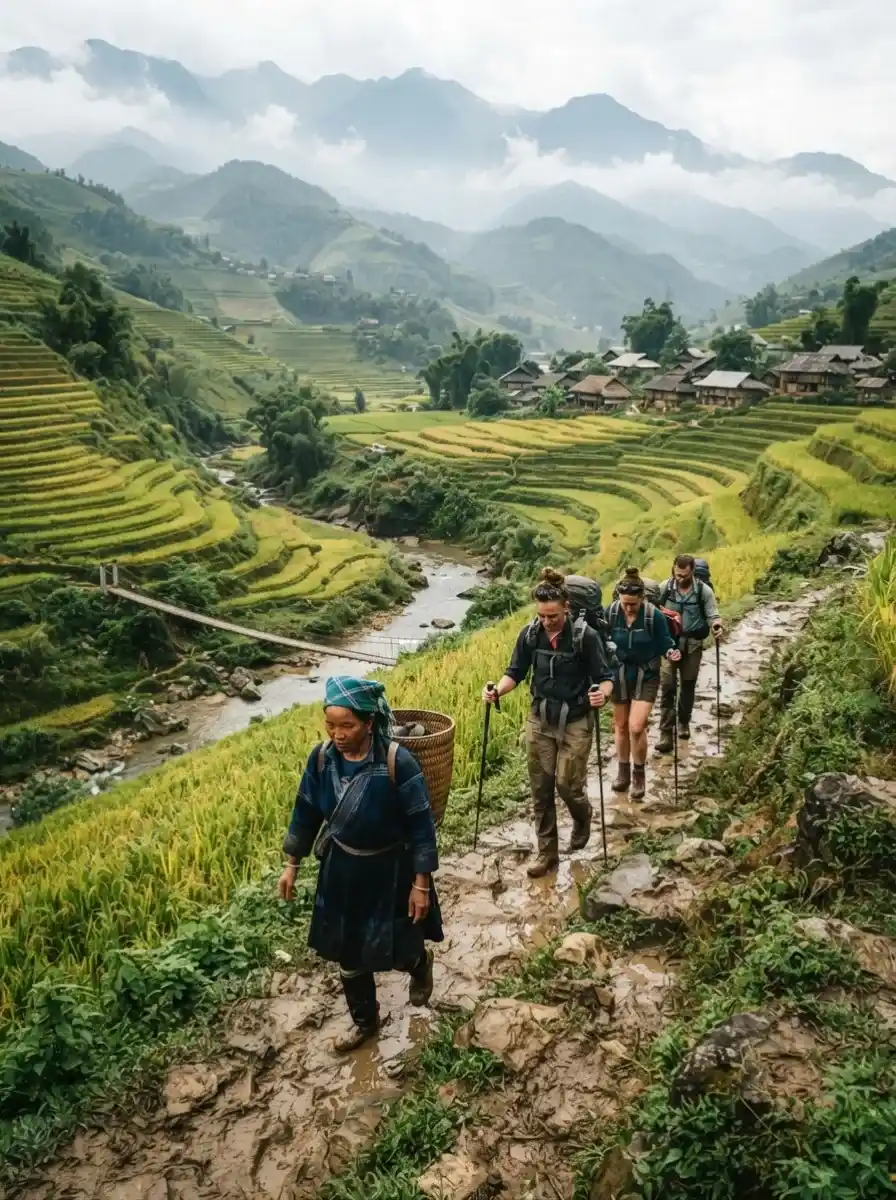
A few rules I picked up the hard way, worth passing on. First: check the weather before you commit to anything — fog can swallow the valley whole for days at a time. Second, learn to disregard tourists; Sapa is popular for a reason, and if crowds genuinely bother you, treat Ba Be alternative destinations as your backup plan. Third, book a hotel heater if you’re visiting in winter — temperatures can drop to 2°C, and no view is worth being that cold indoors. Fourth, decline souvenir solicitations politely but firmly; most handmade goods sold on the trail are actually made in China regardless of what you’re told. Fifth, simply enjoy landscapes when the weather cooperates — that’s the whole point of coming. And sixth, be a responsible tourist: the Booklet for Mindful Travellers PDF, put together with input from Action Solidarité Nord Vietnam, an NGO working in the region, is genuinely useful reading on ethical engagement — particularly around the uncomfortable reality of children selling goods on the trail, which every visitor should think seriously about before handing over cash.
Map of Sapa
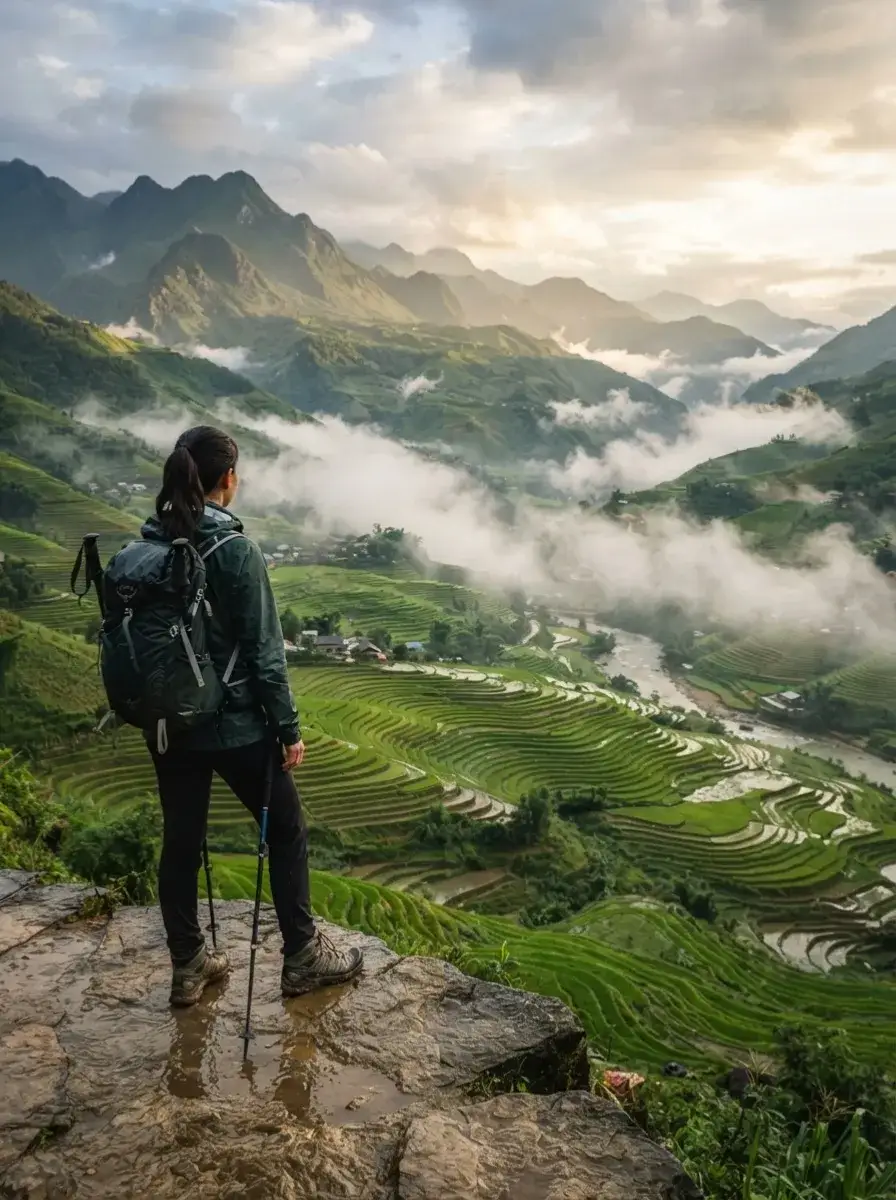
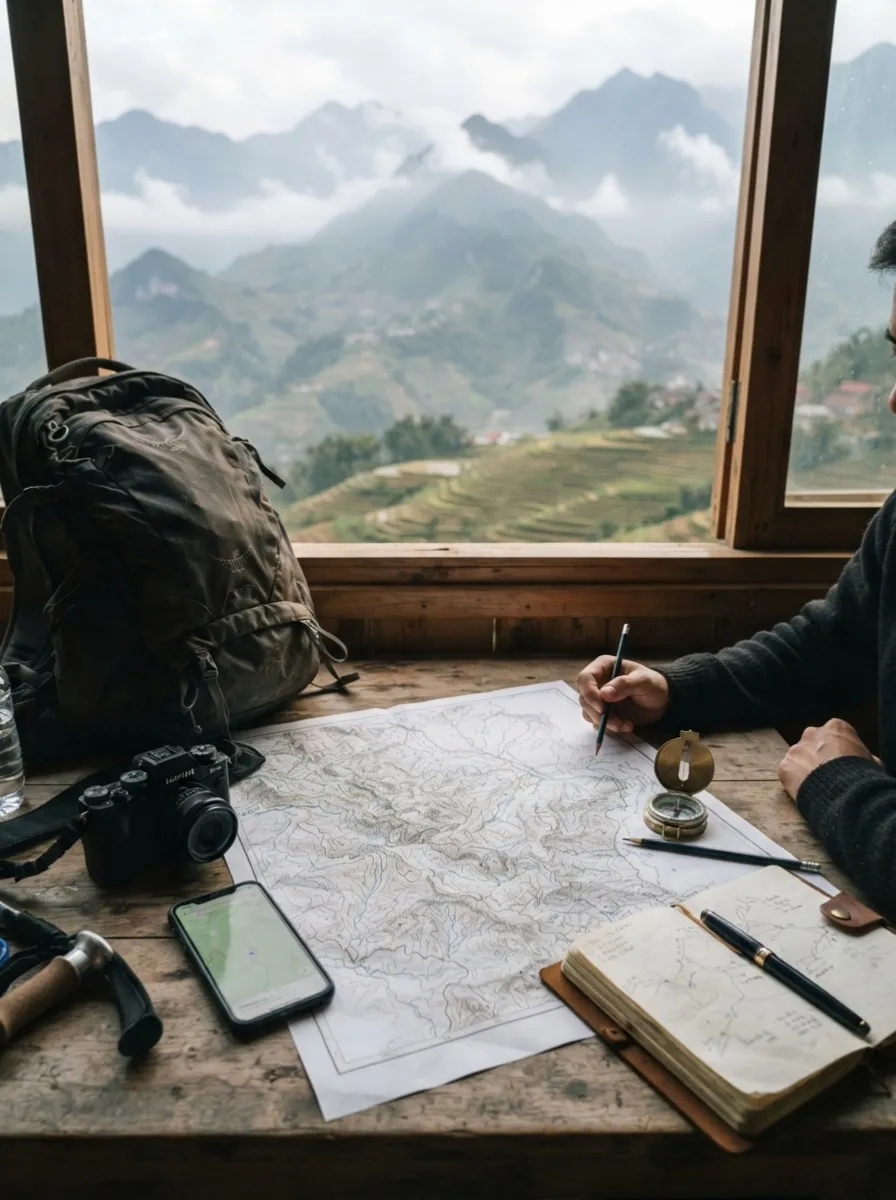
For anyone laying out a route in advance, a custom map built on Google My Maps covering the whole Sapa region is genuinely worth building or borrowing — it turns abstract village names into something you can actually use for real trip planning, especially once you start layering trailheads, homestays, and market days onto the same view.
Is Sapa Worth It? (Conclusion / Review)
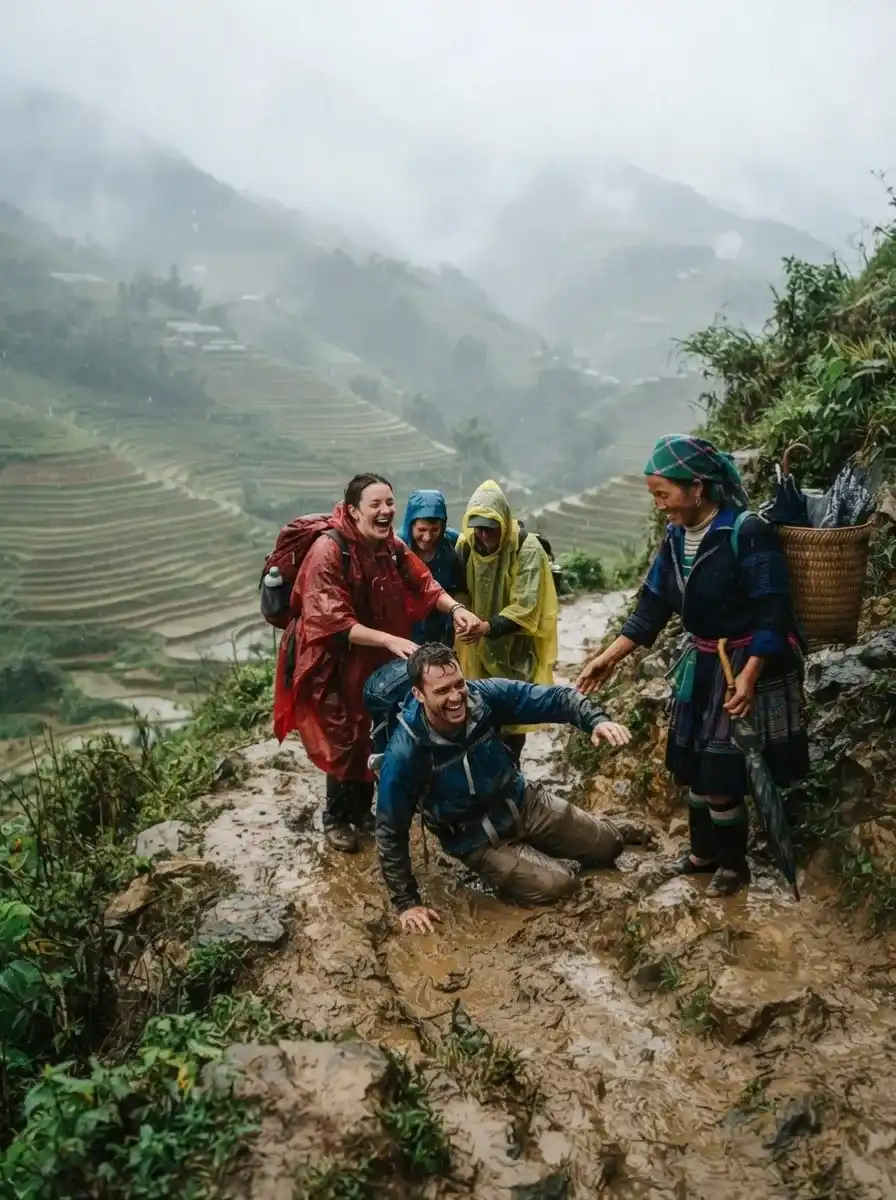
So, is it worth it? My honest verdict: yes — even accounting for the constant rain and the inevitable mud that gets into everything by day two. I’ll admit I only scratched the surface on my own trip, and I’ve already started planning a return for a proper longer village experience next time. If you take one thing from this whole guide, let it be this: pack real waterproof gear and extra spare socks, because you will need both.
It’s also fair to acknowledge Sapa has become a genuinely commercialized region — there’s no pretending it’s some undiscovered corner of Vietnam anymore, and calling it a touristy region isn’t an insult, just an accurate description. None of that stopped it from being a good experience overall, though how good depends heavily on conditions, since the whole trip is fairly weather-dependent. If I were booking again, I’d go straight to one of the socially responsible agencies mentioned earlier, simply because the local community benefit matters more to me now than it did the first time around.
Unique Personal Narrative Sections
Every personal trip report from Sapa seems to follow the same emotional arc, even when the writers never crossed paths. There’s always an Into the Clouds stretch early on — first climb, first rain, first reality check about the terrain — followed by a Go With the Flow phase where your carefully planned small group merges with someone else’s louder one and you just accept it. Then comes the inevitable More More More chapter, usually built around a homestay dinner and a rice wine ritual pushed by whichever host Mao-type figure is running the house that night, refusing to let your bowl stay empty. A gentler Meet Cute moment tends to follow, usually involving village children running out to wave. By the second day, once the crowd thins to a smaller group, the tone shifts into something closer to Life on the Road — deeper conversations, less performance, more actual connection — before the final trek day wraps things up with a Back to Tourist Town return to civilization.
My own version had its own texture: a properly rainy-day trek where half our group had come prepared with real ponchos and the other half were genuinely unprepared friends soaked through within the hour, including one group member fall flat into the mud that still gets brought up as a joke. What actually saved the day were local women, some well into their 70s, who appeared from nowhere and started guiding down slippery paths without being asked — a handmade goods purchase afterward felt less like a transaction and more like an honest thank-you gesture. We ended up cutting trek short because of the weather and rerouted straight to the Good Morning Vietnam restaurant back in town, which more than made up for the disappointment.
Other accounts stick with me too — the chaotic Lao Cai bus station arrival, where a wall of Hmong saleswomen meets every bus before you’ve even found your bag; the classic bait of a small group promise that turns out to mean joining a 200-person daily procession along the same paths at the same time; the reality that what gets sold as a serious hike is often just an easy 10 km walk. One writer’s honest take on the business of authenticity stuck with me most — pointing out that the elaborate festival dress worn by some saleswomen isn’t actually everyday wear at all, and raising real discomfort around souvenir selling to children along the trail. My own guide — people just called him guide Mister Ben — turned what could’ve been a transactional few days into something closer to a warm informal relationship, the kind you don’t expect from a paid tour but end up grateful for anyway.