25 Best Things to Do in Florence, Italy (2026 Travel Guide + Local Tips)
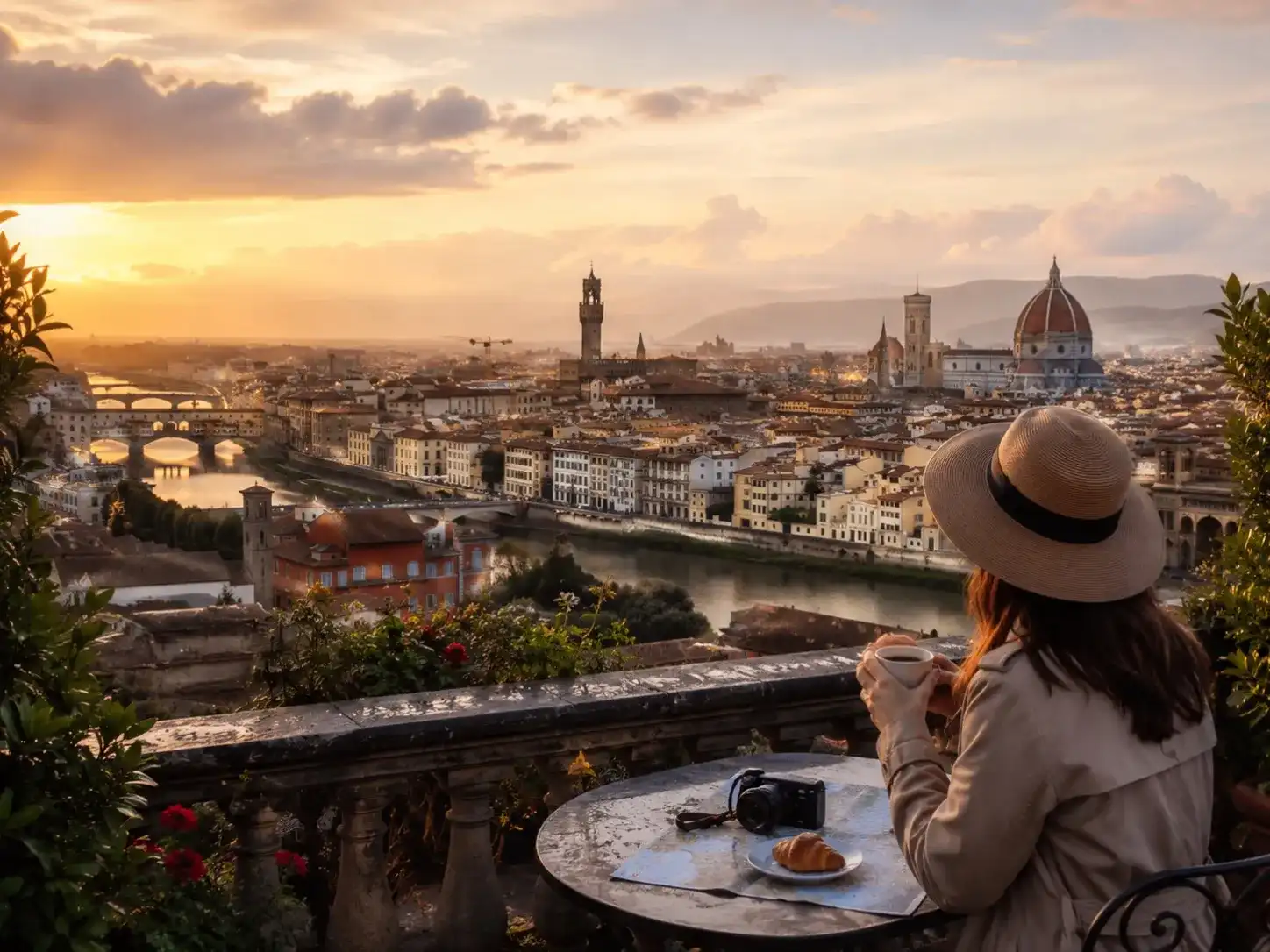
I still remember standing in Piazza della Signoria on our first evening, thinking Florence felt less like a city and more like an open-air museum you could actually walk through. My husband Jeremy and I had put Florence on our bucket list for years, and when we finally booked an Airbnb for a month-long stay in Tuscany, I promised myself I wouldn’t just tick off the Duomo and call it done. Florence is a compact, walkable, expensive city, so it pays to have a plan to control costs before you land.
That first trip we came as a small family — me, my mother, our young son, even the dog tagging along on quieter days — and later I came back with friends for what was meant to be a simple weekend getaway. Between the two visits, spread across almost 25 years of loving this country, I’ve learned that Florence rewards a slow-burn city approach: give it a radius of 30-40 minutes on foot and you’ll find the hidden gems tucked behind every monument. This is meant to be a genuine first-trip guide, but it’s built for a second trip too.
Whether it’s raining (and yes, rain does happen even in a living painting like this one) or the sun is setting gold over the rooftops, Florence’s architecture, culture, and history are inescapable. Below you’ll find honest travel tips, activity picks, and hotel picks drawn from 8 nights on the ground, written for time-pressed readers who still want it rewarding to wander rather than rushed through one of the world’s great cities.
Duomo Complex / Cathedral of Santa Maria del Fiore + Brunelleschi’s Dome Climb
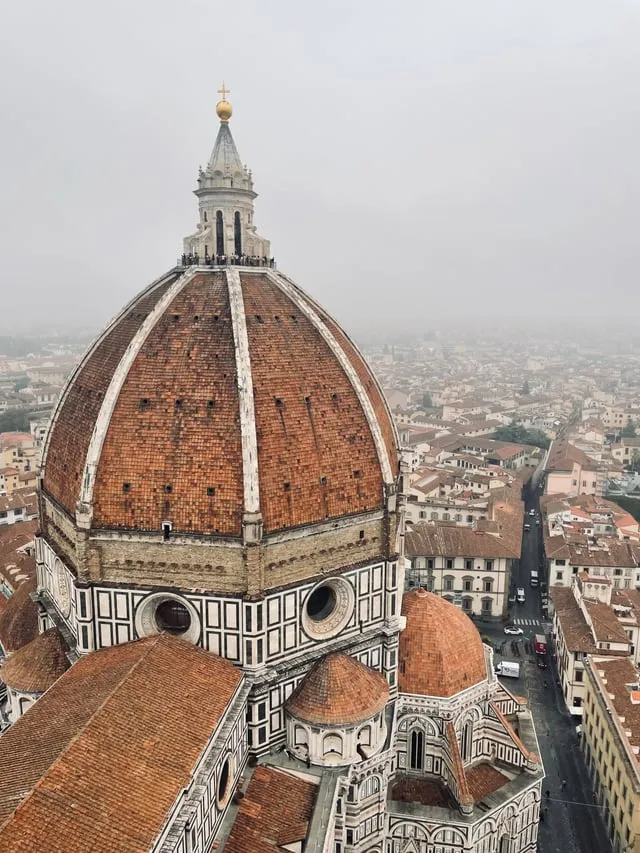
Nothing in Florence Cathedral prepares you for the scale of Brunelleschi’s Dome. Built in the 15th century, the cupola is still the engineering marvel of the skyline, and climbing it means tackling 463 steps with no lift — some say 414 steps depending where you start counting, and either way, it is not for anyone with a fear of heights or claustrophobia. At the top, Vasari and Zuccari’s enormous Last Judgement fresco wraps around the interior of the cupola before you emerge onto a narrow walkway with the whole of Florence spread beneath you.
The marble facade alone draws crowds, but the cathedral interior, the Crypt of Santa Reparata beneath it, the Museo dell’Opera del Duomo, and the Baptistery of St. John are all part of a single ticketed complex most people rush past. I’d recommend the Opera del Duomo Museum and its 5 components as a package — it includes the Baptistery of San Giovanni and can be bought as a 3-day pass, letting you spread the dome climb tickets, the bell tower, and the museum across a few mornings instead of cramming them into one exhausted afternoon.
Because it’s the most-visited site in the city, queuing without a pre-booked time slot is a mistake. Book directly on the official Duomo site, or through a guided tour if you want context along the way; either way, aim for advance online booking 3 weeks out, and for the cupola itself, months in advance during summer since it regularly sells out. The after-hours climb is worth the premium if your schedule allows it — far fewer people, better light. Options like the Brunelleschi Pass run about €30 with access valid for 72 hours, while the slimmer Giotto Pass at roughly €20 covers Giotto’s Bell Tower and skips the dome. General entry to the cathedral itself remains free general entry, so check opening hours and remember the strict cathedral dress code before you go — bare shoulders will get you turned away at the door for timed entry slots too.
Piazza del Duomo (the square itself)
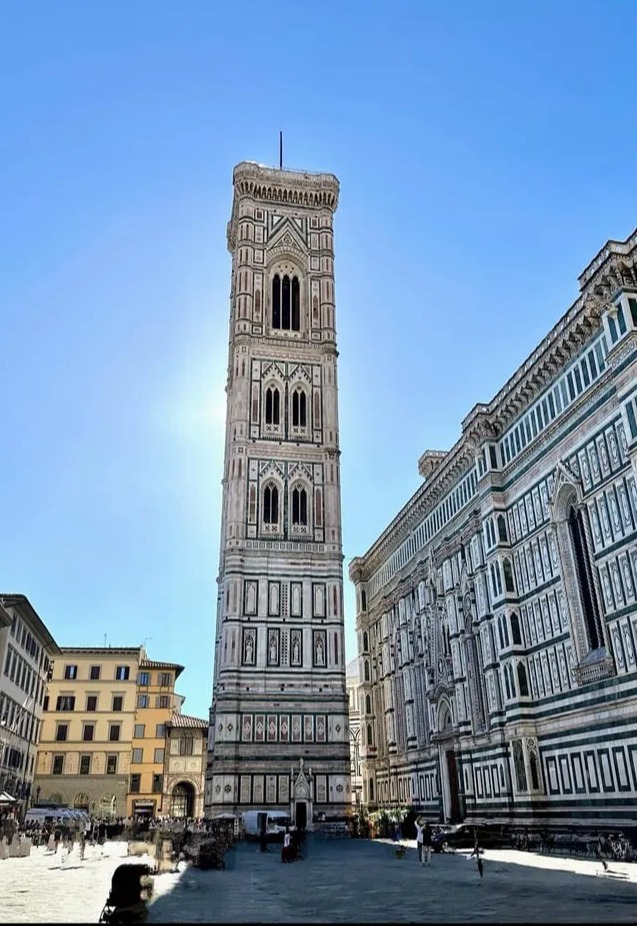
By mid-morning, the Duomo square turns into the prettiest piazza you’ll ever curse for being so crowded. It’s genuinely chaotic by day — tourists, vendors, hawkers, musicians, and singers all competing for space while everyone tries to photograph the cathedral from the same three angles. There’s little shade, and in summer heat that matters more than you’d think. I go back for an evening visit instead, when the crowds thin into a far calmer atmosphere and the facade catches the last light without fifty phones in the frame.
Uffizi Gallery
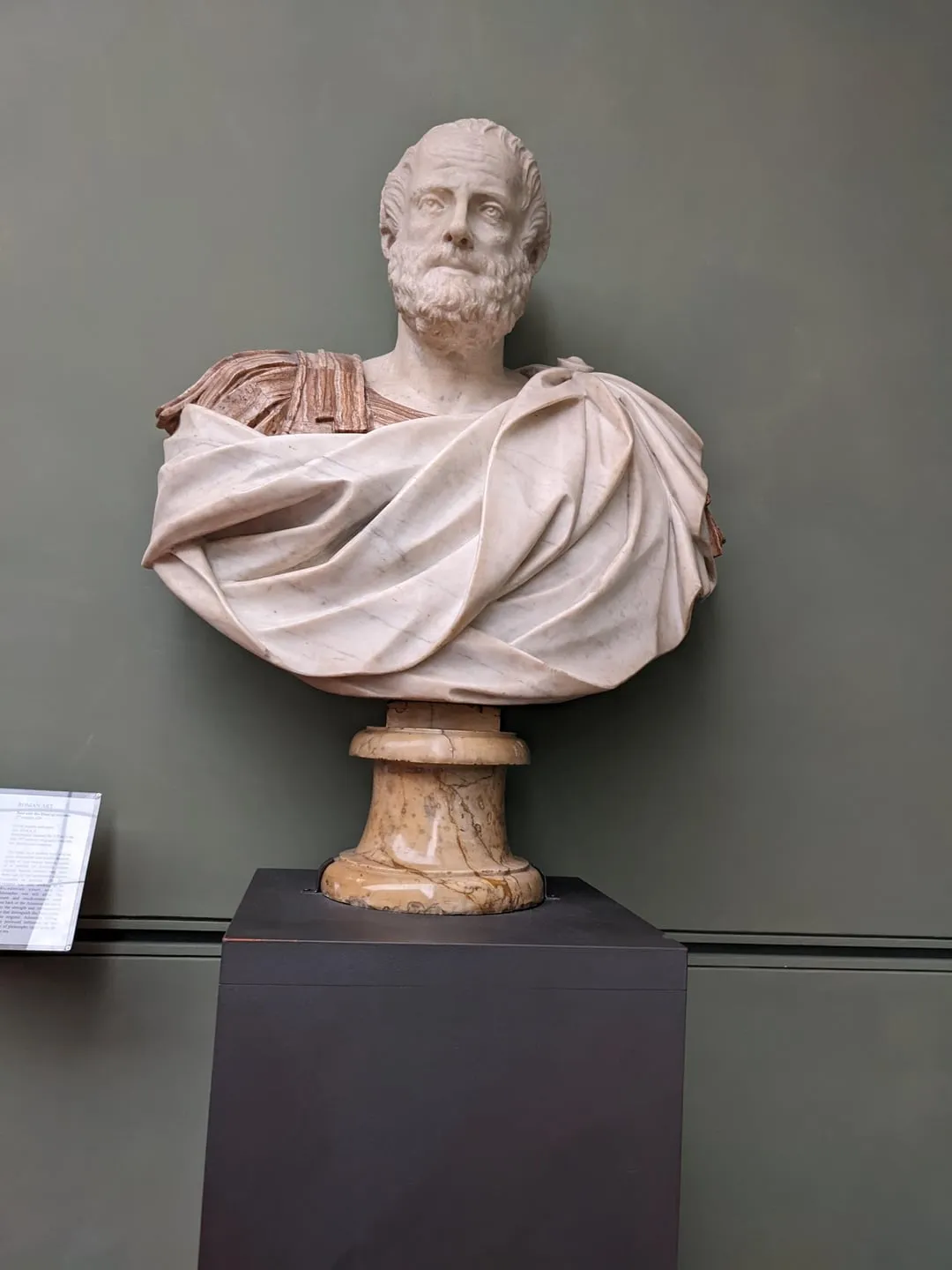
The Uffizi Gallery earns its nickname as the Cradle of the Renaissance — this is where you stand in front of Da Vinci and Botticelli, including the Birth of Venus, and where a handful of rooms of Caravaggio alone justify the visit. Originally built as Medici government offices (the word uffici literally means “offices”), the gallery now holds roughly 50 rooms spanning Western painting from the 13th-18th centuries, and yes, it includes some of the earliest non-biblical female nudes in Western art history, which always surprises first-time visitors. If you’ve read Dan Brown’s Inferno, you’ll recognize the Vasari Corridor, the 750-metre corridor connecting the gallery to the Boboli Gardens connection across the river — it reopened after 8 years restoration and is worth adding on if you can get a reserved-entry ticket.
Budget 2 hours for a fast pass or 3-4 hours if you actually want to absorb it. Advance tickets are non-negotiable in high season given constant sellouts; a guided tour helps if you want the story behind the art rather than just the paintings themselves. Full-price entry runs €25 to €29 depending on season, though there’s a genuinely useful discounted afternoon ticket after 4pm for around €16 to €20. A combined ticket with Pitti Palace runs €43 to €47, or consider the 5-day Passepartout at €40 if you’re planning to see several Medici sites. The gallery is closed Mondays, so book a month ahead and, if you can, aim for the quietest hours right at opening with a timed entry slot already secured.
Galleria dell’Accademia / Michelangelo’s David
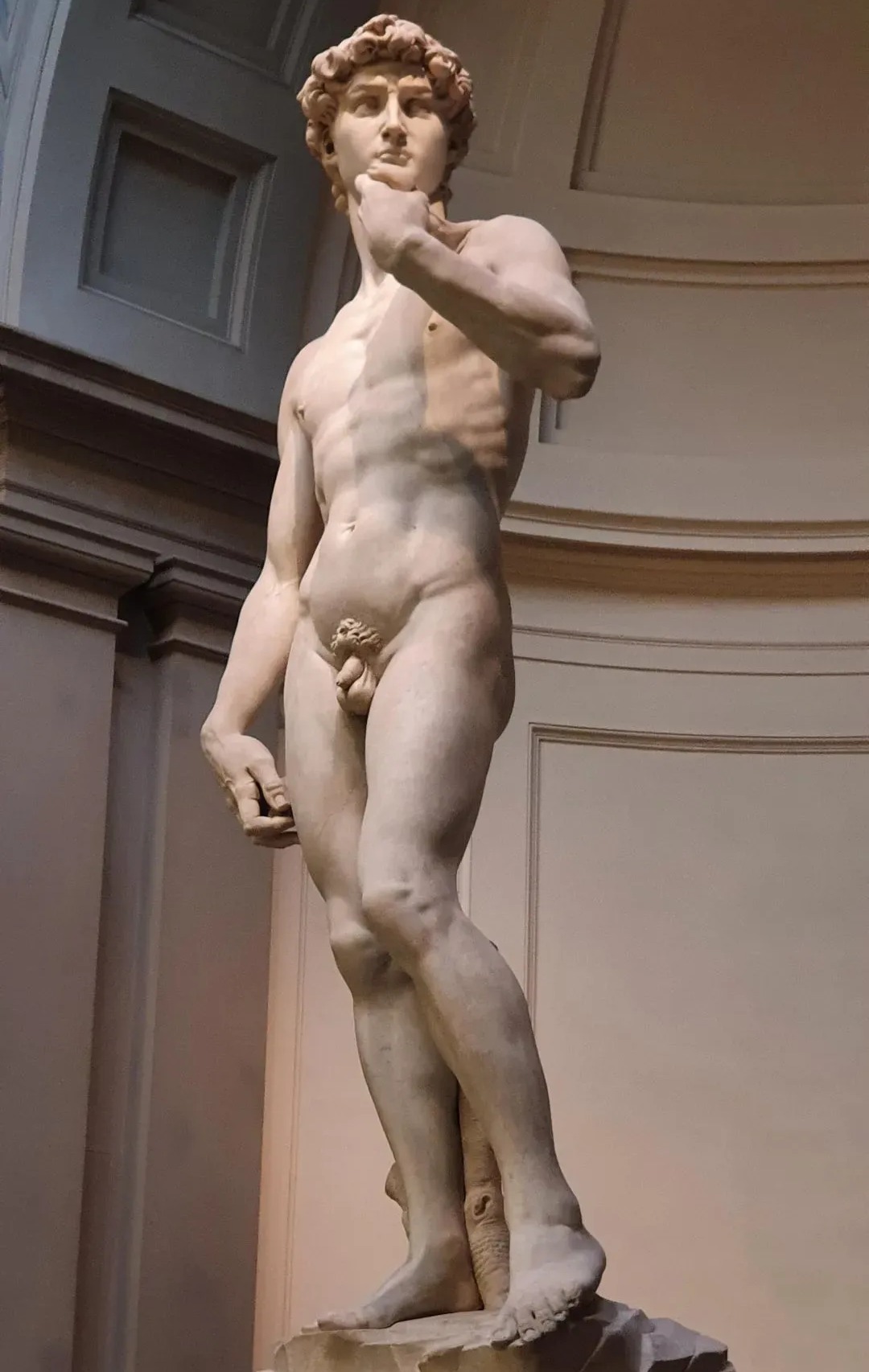
Michelangelo’s David is the reason most people fly into Florence, and no photo prepares you for standing in front of a 1501-1504 figure carved from a single block of Carrara marble. It originally stood in Piazza della Signoria before being relocated 1873 to protect it from weather, which is why the piece you see outside today is a replica of David. Give the Galleria dell’Accademia 1-2 hours, and don’t rush past the unfinished Prisoners, also called the Slaves statues — half-emerged figures still trapped in stone that, honestly, moved me more than the David itself. There’s also a room of plaster molds and a quieter musical instruments room holding Medici and Lorraine instruments that most tour groups skip entirely.
Reservations sell out months in advance for summer, so book through the official site rather than gambling on third-party ticket sites like Get Your Guide unless you want it bundled into a broader tour. A full ticket runs €16, or grab the Bargello combined ticket for €26; either way, book at least 48 hours ahead. Opening hours run Tue-Sun, 8:15am-6:50pm, closed Mondays and public holidays, so book months ahead if you’re traveling in summer. This 19th-century museum holds the largest concentration of Michelangelo sculptures anywhere, so a secured timed entry slot is the only real defense against the daily crowding.
Piazza della Signoria & Palazzo Vecchio (incl. Loggia dei Lanzi)
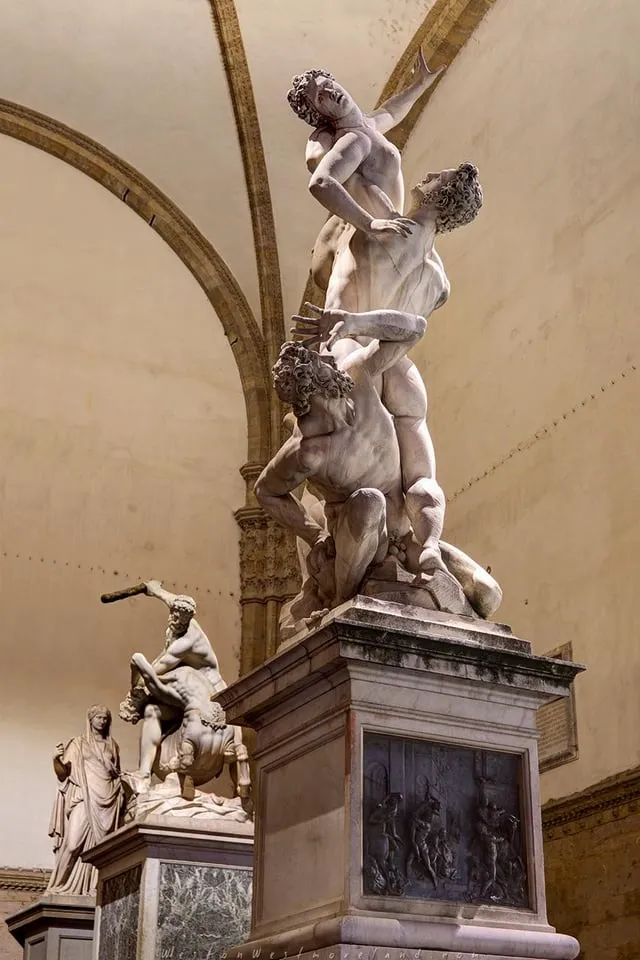
If Florence has a single central heartbeat, it’s this square. Palazzo Vecchio still functions partly as City Hall and partly as museum, and the piazza around it is where buskers, occasional demonstrations, and the daily crowds converge around free-to-view statues. Under the Loggia dei Lanzi, the original statues are essentially an open-air sculpture gallery at no cost: Cellini’s Perseus with the Head of Medusa and Giambologna’s Rape of the Sabine Women sit a few feet from tourists eating gelato, alongside a copy of the Fountain of Neptune — Neptune’s Fountain — and a David replica standing roughly where the original once stood.
Because of the Uffizi proximity, this is also where I’ve eaten more panini than I’d admit, usually from All’Antico Vinaio with a panino in one hand and gelato in the other while I people-watch from the steps. Historically this was the seat of government as far back as the 13th century, anchored by the soaring Arnolfo Tower; today the Old Palace interior requires a separate ticket to see the Salone dei Cinquecento — the Hall of the Five Hundred — with its enormous Vasari frescoes celebrating Florentine military victories, plus secret passages and preserved Medici apartments that make for a genuinely under-visited view of the building. Full price runs €19, and under-18s free entry applies; book through the official booking site since this remains the political heart of the historic center and one of its key landmarks.
It’s also, without question, the most crowded spot on any historic center walk, so morning crowds are real and a ticket required for the inner rooms is worth planning around. The inner courtyard, filled with sculptures and paintings, sits inside a 14th-century ceremonial building raised on an elevated platform with distinctive arches. Go early morning or late evening and the same square that felt overwhelmingly busy at noon turns almost deserted and genuinely pleasant — a small trick that took me three trips to figure out. As a symbol of Florentine freedom, the David stood here from 1504-1873 before being replaced with copy, and honestly that history is worth a few extra minutes just standing still in the square.
It’s worth pausing here for a quick look at Florence’s history, because this square is where most of it played out. Florence began as a Roman settlement around 59 BCE, but its real fame comes from becoming the epicenter of the Renaissance under Medici patronage in the 15th century, when Brunelleschi, Botticelli, Da Vinci, and Michelangelo were all working within walking distance of each other. The Medici family built their fortune on a private banking system before becoming patrons of the arts on a scale that reshaped the city — Lorenzo the Magnificent alone was a Michelangelo patron, and the family later produced multiple popes and commissioned the Vasari Corridor so they could move between palaces without ever touching the street. Behind the art, though, ran genuine betrayals and political intrigue, most infamously the Easter Sunday incident, when a rival family attempted to assassinate the Medici brothers inside the cathedral itself. A dedicated Medici walking tour covers this properly, and if you want to go deeper, The House of Medici book is still the most readable single account I’ve found. Their burial site, the Medici Chapels attached to the Basilica di San Lorenzo, is criminally under-visited given how central this family is to everything else on this list. Eventually the family’s grip faded through political upheaval and the slow Medici decline, culminating in Florence’s role in the unification into modern Italy — the city today stands as a genuine living testament to all of it.
Ponte Vecchio
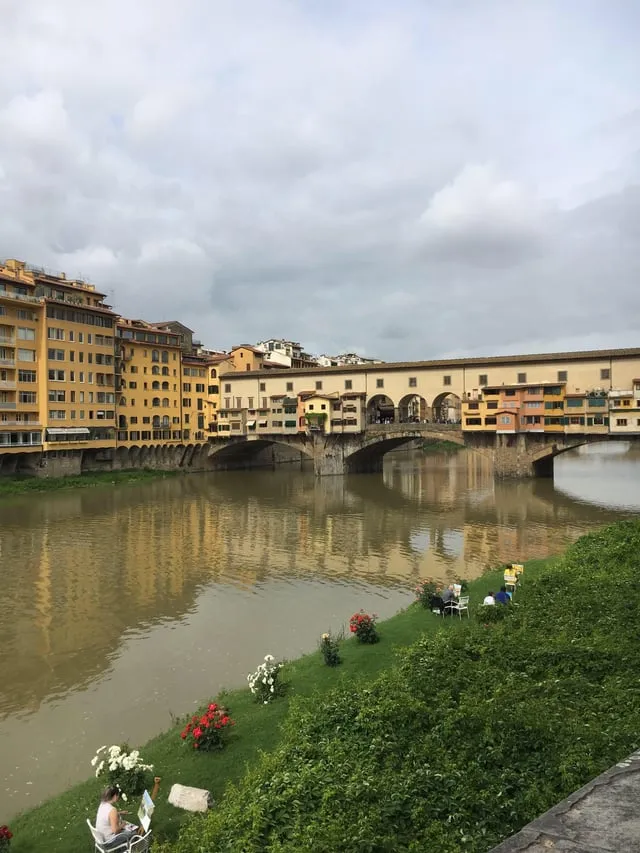
Florence’s oldest bridge — and yes, some guides still call it the first-standing bridge across the Arno river — traces its Roman roots back centuries, though it’s been rebuilt many times since. What you see today, lined with gold shops and jewelry shops, dates from 1565 under the Medici, who ordered the original butchers banned and tanners banned from the bridge because of the odor, replacing them permanently with jewelers. Above it all runs the Vasari Corridor passing above the shops, a private walkway from medieval times that the ruling family used to avoid the crowds entirely.
Midday crowds here are relentless, so I always send people to the Ponte Santa Trinita view instead, one bridge over, for the classic photograph Ponte Vecchio shot with fewer crowds and none of the elbow-to-elbow shuffle. Time it for late afternoon light and you get the houses built on bridge silhouetted against the riverbanks view, or come back after dark for evening musicians playing along the water — genuinely one of my favorite pockets of ambiance in the city, and a personal favorite stop even after multiple trips. The distinctive rows of shops make it the oldest bridge in Florence and arguably the most famous bridge in the world, first built in 1345 and still the anchor point of any historic-center walking route. Grab a gelato pairing from a nearby shop before you cross — it makes the whole stop feel less like a photo op and more like an actual afternoon.
Piazzale Michelangelo (Sunset Viewpoint)
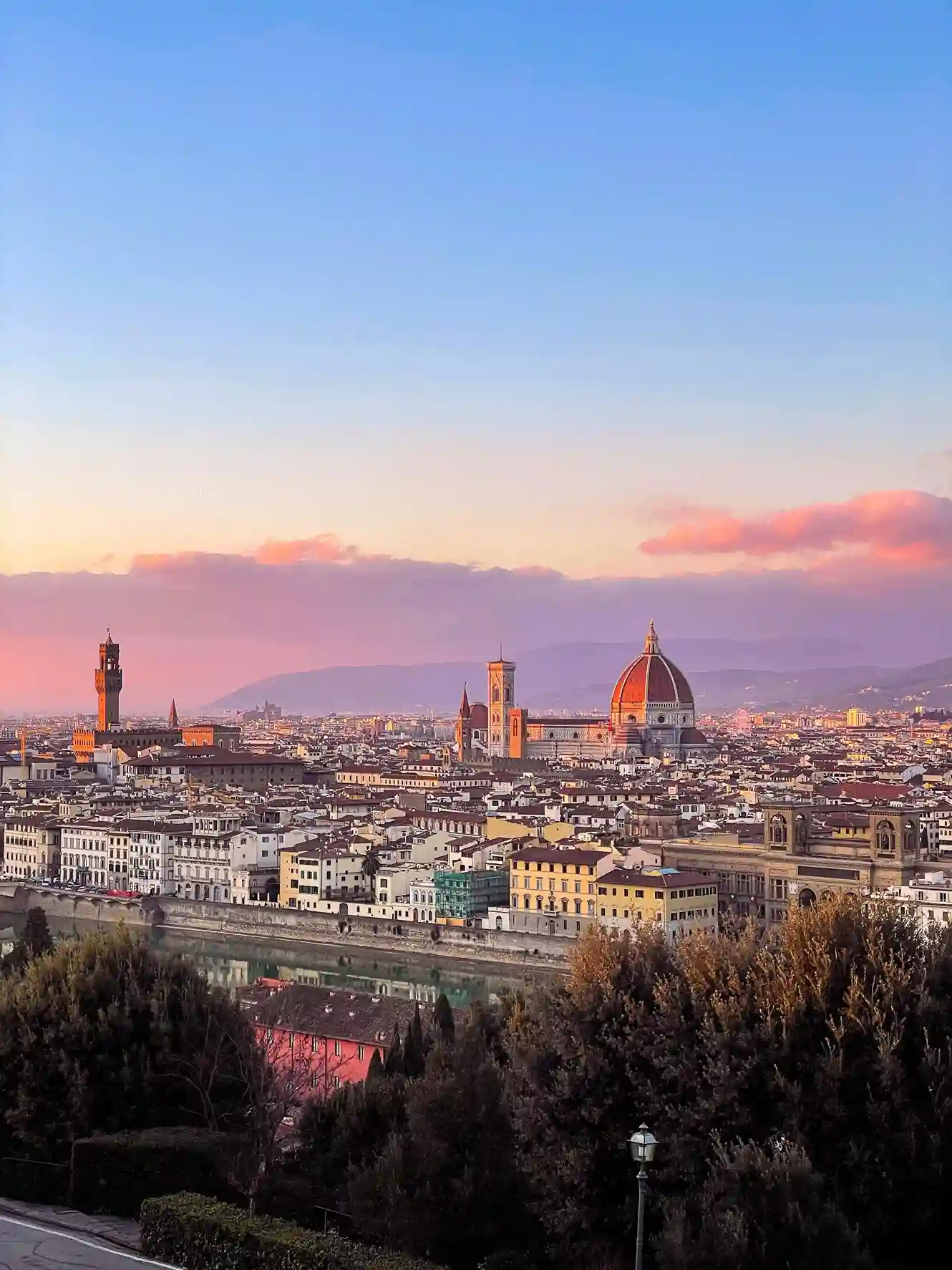
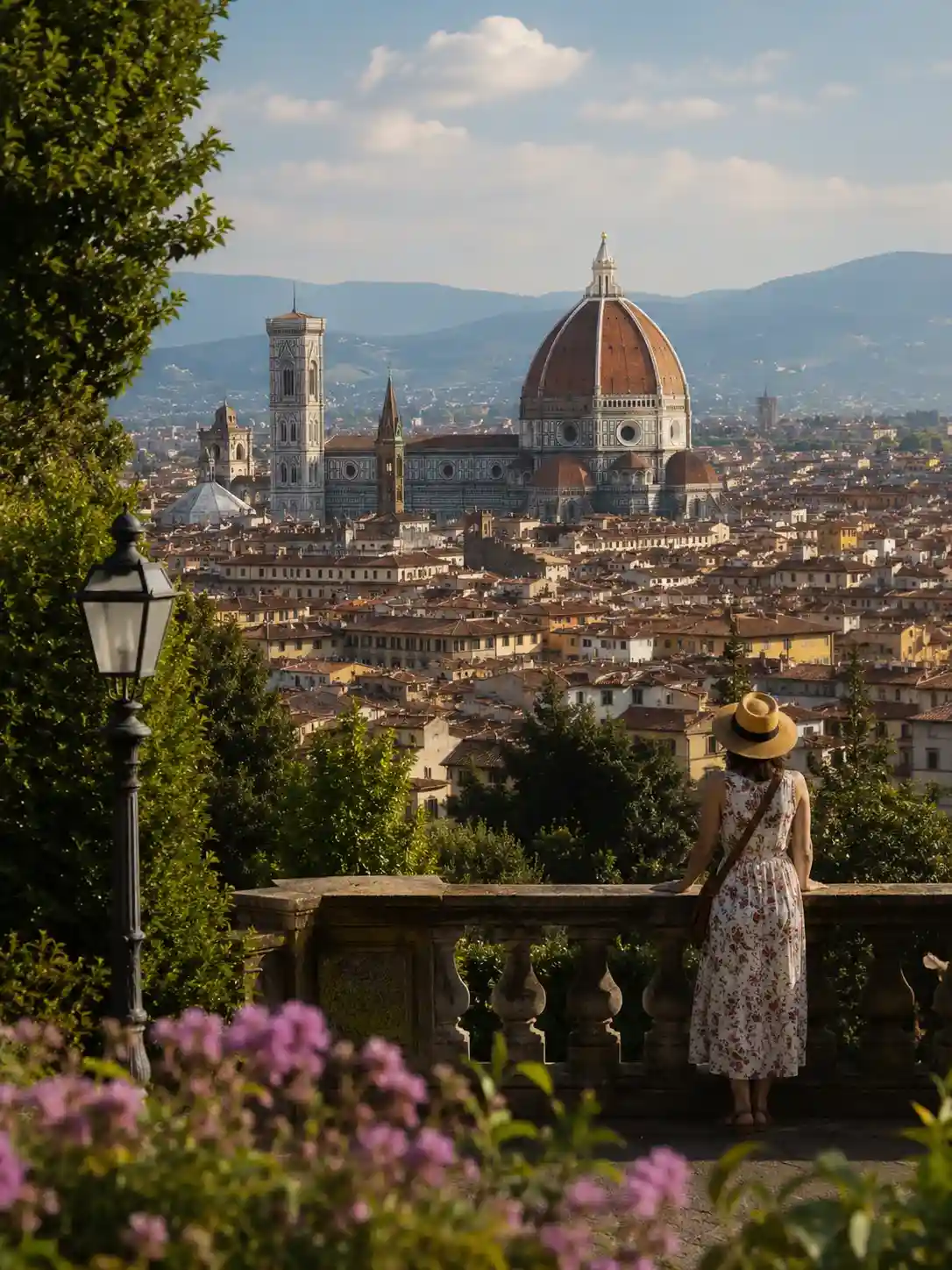
Everyone knows about the free sunset view from Piazzale Michelangelo, which is exactly why it’s extremely crowded most evenings. The panorama is real — you get the Duomo view, the Palazzo Vecchio view, the Ponte Vecchio view, and the Arno view all in one sweep, with the Tuscan hills rolling out behind the city. It’s a 20-minute uphill walk from the center, or you can catch bus 12 or bus 13 if you’d rather save your legs.
This remains the most popular sunset spot for travelers, students, and locals alike, so if you want a good spot, arrive an hour before sunset — some locals push that to 1.5 hours before sunset in peak season. Bring wine and snacks and make it a proper lingering spot rather than a five-minute photo stop; just watch belongings in the crowd. If climb the hill sounds like a lot, the bus stops right at the Giardino delle Rose stop, roughly 45 minutes before sunset timing works well from there too, for what’s simply one of the best panoramic viewpoint stops in the city.
San Miniato al Monte
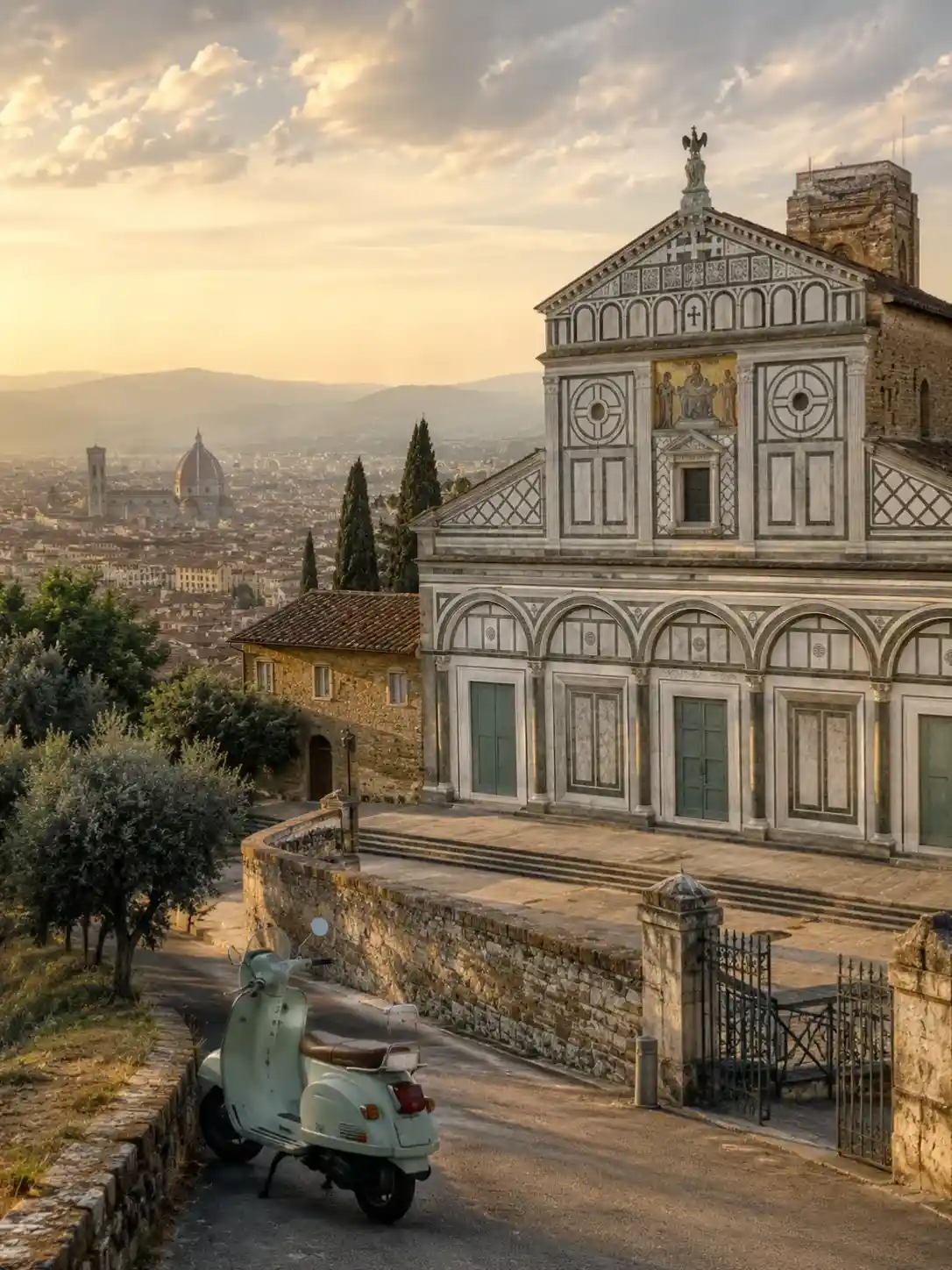
For a higher quieter alternative, keep continuing the climb past Piazzale Michelangelo to San Miniato al Monte. It’s only a few minutes further, but the crowds drop off almost completely, which is exactly why locals prefer it. The Romanesque facade, done in green-and-white marble, hides an intricate marble floor and genuinely stunning Byzantine-style mosaics inside — I’d argue this hilltop church has better panoramic views than its more famous neighbor. Check the church schedule; if you catch the Benedictine monks singing Latin chants or Gregorian chants during vespers, it’s worth timing a late afternoon visit around it.
A number of operators run a vintage Vespa tour that loops through this hillside, often building in a San Miniato al Monte stop followed by an olive orchard and a scenic picnic overlooking the valley — a genuinely different way to see this side of the city if you’ve already done the walking-tour circuit once.
Markets (Mercato Centrale / Sant’Ambrogio / San Lorenzo Leather Market / General Markets)
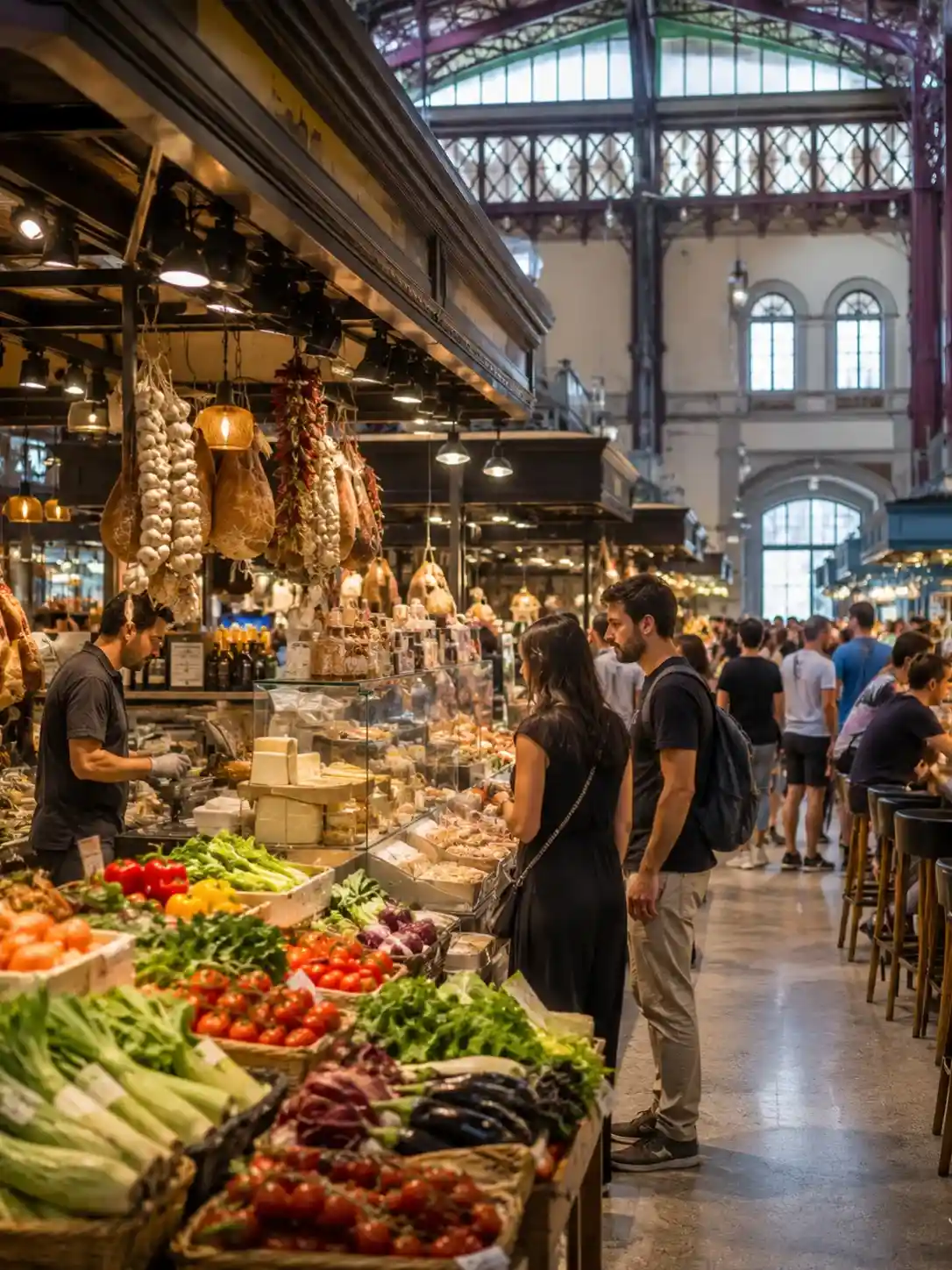
Mercato Centrale is the easiest one-stop introduction: raw food downstairs with fresh produce, cheeses, cured meats, and pasta on the ground floor, and a lively food hall upstairs with prepared food upstairs serving everything from lampredotto to wood-fired pizza and local craft beer — a solid casual lunch stop even with kids in tow. Outside, Mercato San Lorenzo runs as more of a souvenir market blended with the leather market, where the San Lorenzo leather stalls are worth a quality check and a bit of confident negotiate-ing before you buy.
If San Lorenzo feels like too much, Mercato Sant’Ambrogio is the calmer alternative — this is the locals’ market, a bit less polished, best visited on a morning visit for a fried seafood cone or a bowl of tripe stew at a nearby trattoria. For something rarer, look for the Mercato delle Pulci flea market, a rotating seasonal farmers market, or an occasional artisans market around Piazza Santo Spirito. For proper leather, skip the stalls entirely and head to a real leather artisan shop — the School of Leather, formally the Scuola del Cuoio, runs a leather school showroom through a former chapel entrance behind Santa Croce, alongside respected names like Misuri and The Gallery Michelangelo. Going early means fewer crowds for window shopping, colorful photos, and generally a better experience if you’re one of the souvenir hunters, though the area does get properly crowded, so watch children closely if you’ve brought them. Some travelers even build a full market food tour around these stalls in the Oltrarno workshops and Santa Croce leather school area.
Just past the markets, budget a stop for panino lunch spots: All’Antico Vinaio global chain has become genuinely famous, but I actually prefer the smaller Il Panino del Chianti or Il Cernacchio for a quick lunch that’s inexpensive and comes with a real staff recommendation rather than a queue — either way, plan to avoid long lines by going slightly off peak hours.
For something more particular, hunt down a working historic wine window, one of the old buchette del vino cut into building facades during the 1630 bubonic plague for contactless wine sale — the tradition was revived 2020 by a local cultural association, and you can still get a glass at spots like Babae, Cantina dei Pucci, La Buchetta Food & Wine 2, Osteria Belle Donne, or DiVin Boccone. And if perfume is your thing, the Officina Profumo-Farmaceutica di Santa Maria Novella is the city’s oldest apothecary, founded by 13th-century Dominican friars who originally sold medicinal herbs before it evolved into a high-end perfumery — nearby AquaFlor is a good second stop if the first one’s queue is long.
Boboli Gardens & Palazzo Pitti
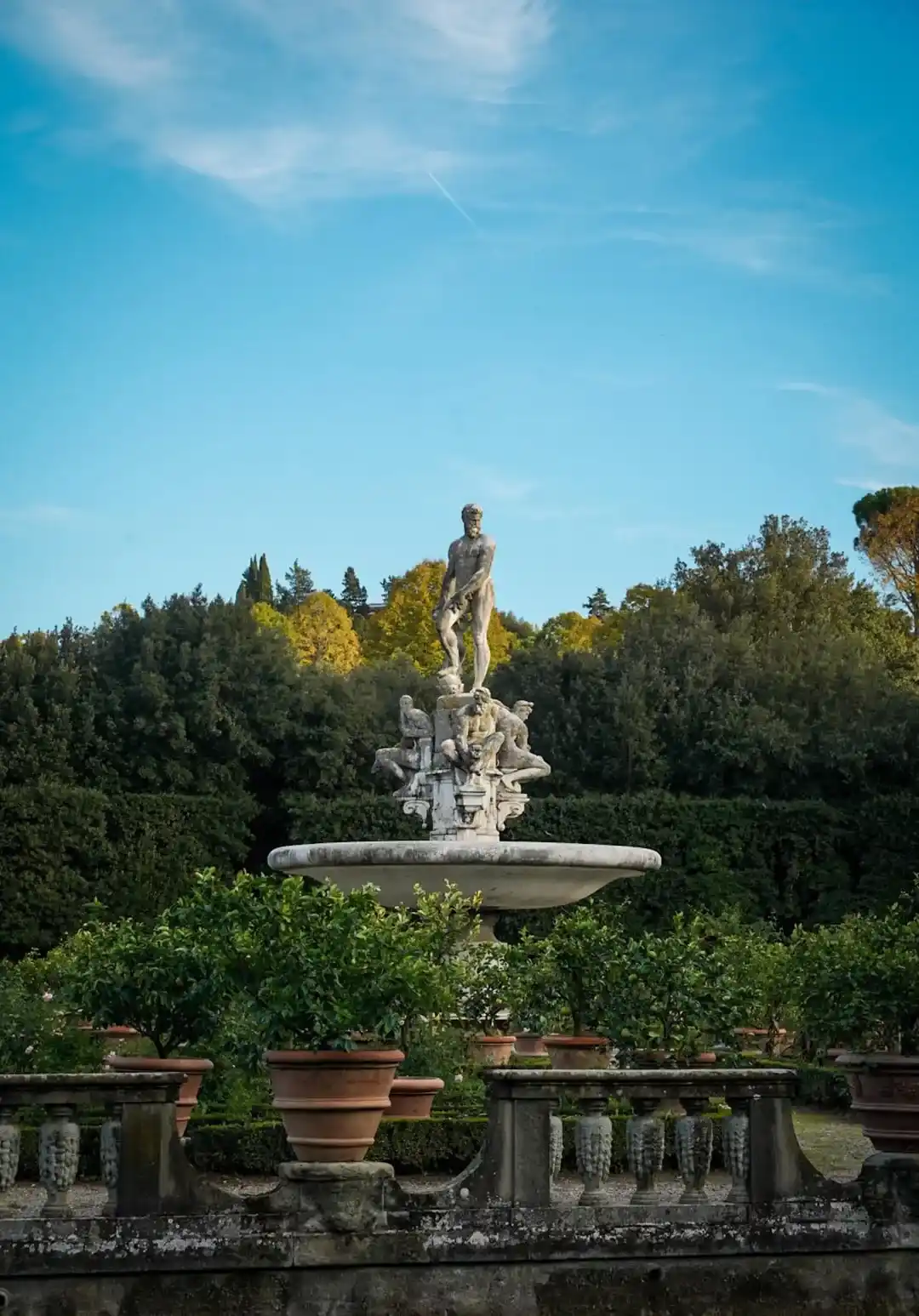
The Boboli Gardens were originally laid out as the Medici family gardens in the 16th century, and at 11 acres they’re big enough to genuinely lose the crowds in, especially if you climb toward the Casino del Cavaliere and its small Porcelain Museum at the garden’s highest point. Note that parts have periodically been closed for updates in recent seasons, so check availability before you buy timed-entry tickets — book through the official site rather than third-party sellers.
The famous building attached to the gardens, Palazzo Pitti, gets bypassed by a surprising number of visitors, which is a shame given the Palatine Gallery, the Royal Apartments, and rotating temporary exhibits inside. Originally a 15th-century Medici residence, it later housed Napoleon and today holds strong Renaissance paintings alongside the Gallery of Modern Art and its excellent Macchiaioli works, plus the Costume and Fashion Museum and the Treasury of the Grand Dukes. Consider the combined ticket with the Uffizi and Boboli if Pitti is your main residence stop of the day — it once served that literal purpose for the family in the mid-16th century.
Outside, the formal Italian landscape design gives way to fountains, grottos, stepped terraces, and sculpture shaded by rows of cypress trees, making it a genuine escape from crowds even in August. Pricing runs roughly €16 to €19 for Pitti, €10 to €13 for Boboli alone, a combined €22 to €25, or the 5-day Passepartout at €40 if you’re doing several Medici sites together. Everything tends to close an hour before sunset, so a favorite morning visit works better than a late-afternoon dash through exposed gardens during the hottest hours. From the top, it’s a short 5-minute walk to Bardini Gardens access if you want to keep going.
Bardini Gardens / Secret Gardens
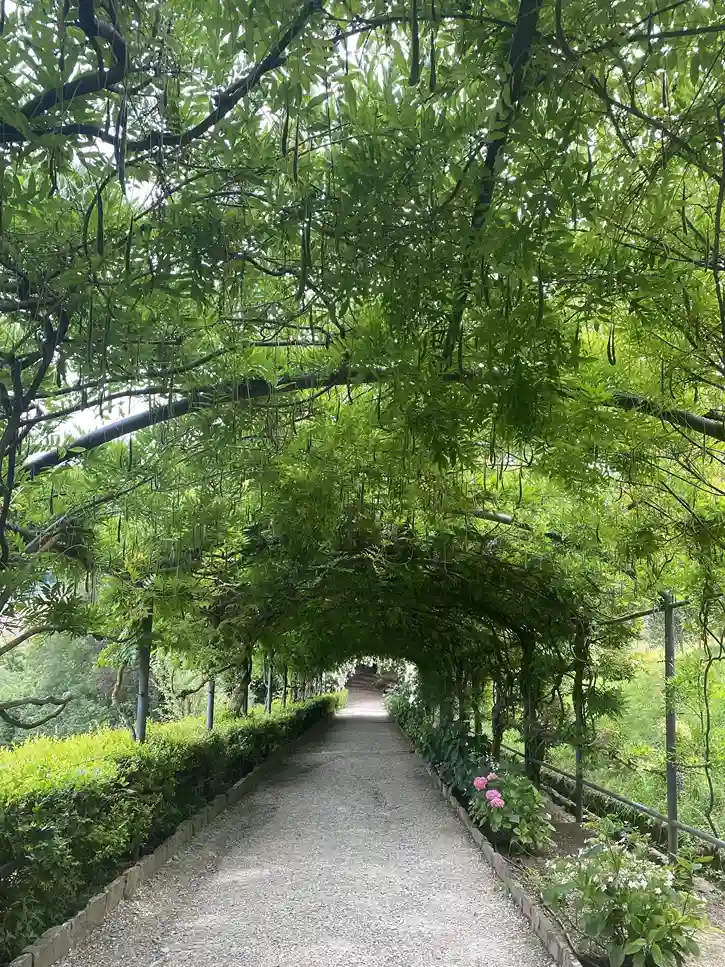
Here’s a genuinely useful tip: your Boboli ticket includes entry to the Bardini Gardens, a smaller garden that stays less crowded even when Boboli is packed, with views over Florence that rival the big-name viewpoints. Come in mid-April through early May for the Wisteria Tunnel, a bucket-list item in its own right when the blooms peak — this terraced hillside garden in the Oltrarno is easily the best-timed spring wisteria bloom in the city and stays quieter than Boboli even during that short window. The grounds also connect to a small art museum, a costume museum, and a private villa.
Nearby, the Giardino delle Rose, or Rose Garden, offers free entry and around 350 rose varieties in bloom, alongside sculptures by Jean-Michel Folon scattered through the grounds — best visited in May or June for a proper panorama backdrop. It’s a five-minute walk and sits conveniently en route to Piazzale Michelangelo, making it a natural sunset stop on the way up the hill.
Basilica di Santa Croce
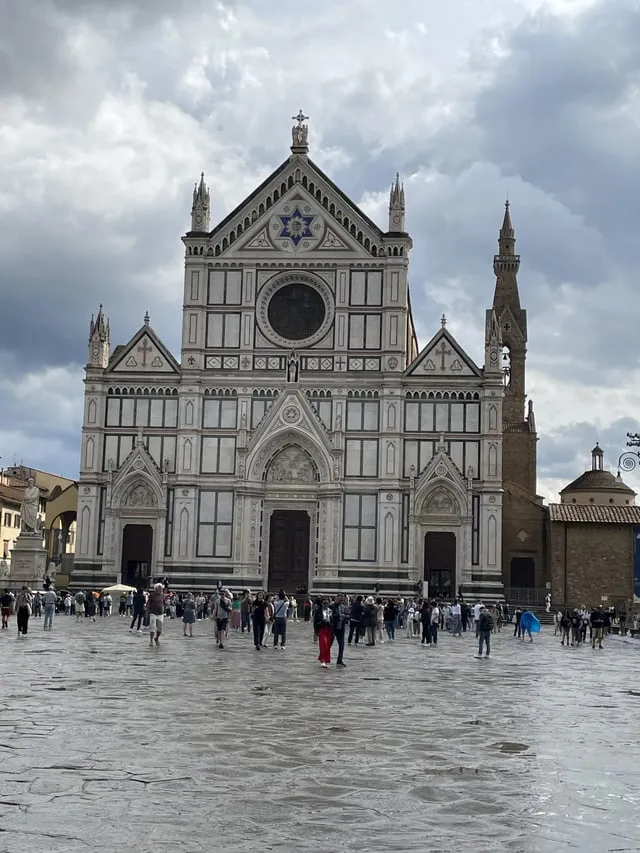
Basilica di Santa Croce is essentially the city’s Pantheon: the Michelangelo tomb, Machiavelli tomb, and Galileo tomb all sit here, alongside a Dante memorial (his actual remains are in Ravenna) and a Da Vinci memorial. It’s the second-busiest church in Florence, so grab timed-entry tickets ahead rather than queuing on Piazza Santa Croce, which itself transforms into a Christmas market during the holiday season and hosts the historic calcio storico football match in summer — genuinely wild to witness if your dates line up.
Sometimes called the Pantheon of Italian Glories, it’s also the resting place of composer Rossini and holds an important cycle of Giotto-school frescoes. Beyond the main nave, the peaceful cloister is worth the extra few minutes, and because the whole complex sits slightly east of tourist cluster territory, it never feels quite as overrun as the Duomo. This remains one of the largest public squares in the city, dating to 1295 and designed by Arnolfo di Cambio; the church itself is still an active Franciscan church, with general entry running €8-10 entry.
Basilica of Santa Maria Novella
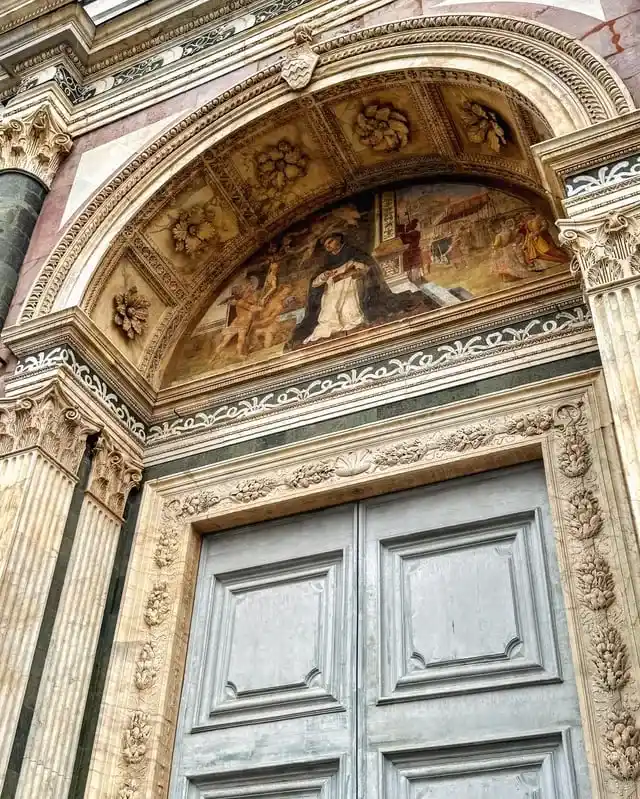
As Florence’s first major church, sitting right by the train station exit, this Dominican basilica dates to the late 1200s and rewards a slower visit than most people give it. Inside, the 15th-century frescoes in the Filippo Strozzi Chapel and the Tornabuoni Chapel are genuinely on par with anything in the Uffizi, and the peaceful cloisters attached to the Spanish Chapel, dating from the 1300s, are almost always empty. On our October 2024 visit there was no line and no pre-booking required, which felt like a small miracle after the Duomo.
The green-and-white marble facade, an elegant facade designed by Leon Battista Alberti, is a landmark on its own, but don’t skip the interior — Masaccio’s Trinity and the Ghirlandaio fresco cycle are two of the most important works of the early Renaissance. Officially built 1279, the church honors the Holy Trinity and now operates as a small museum complex with several adjoining chapels, all just steps from the near main train station hub most travelers pass through without a second glance.
Gelato
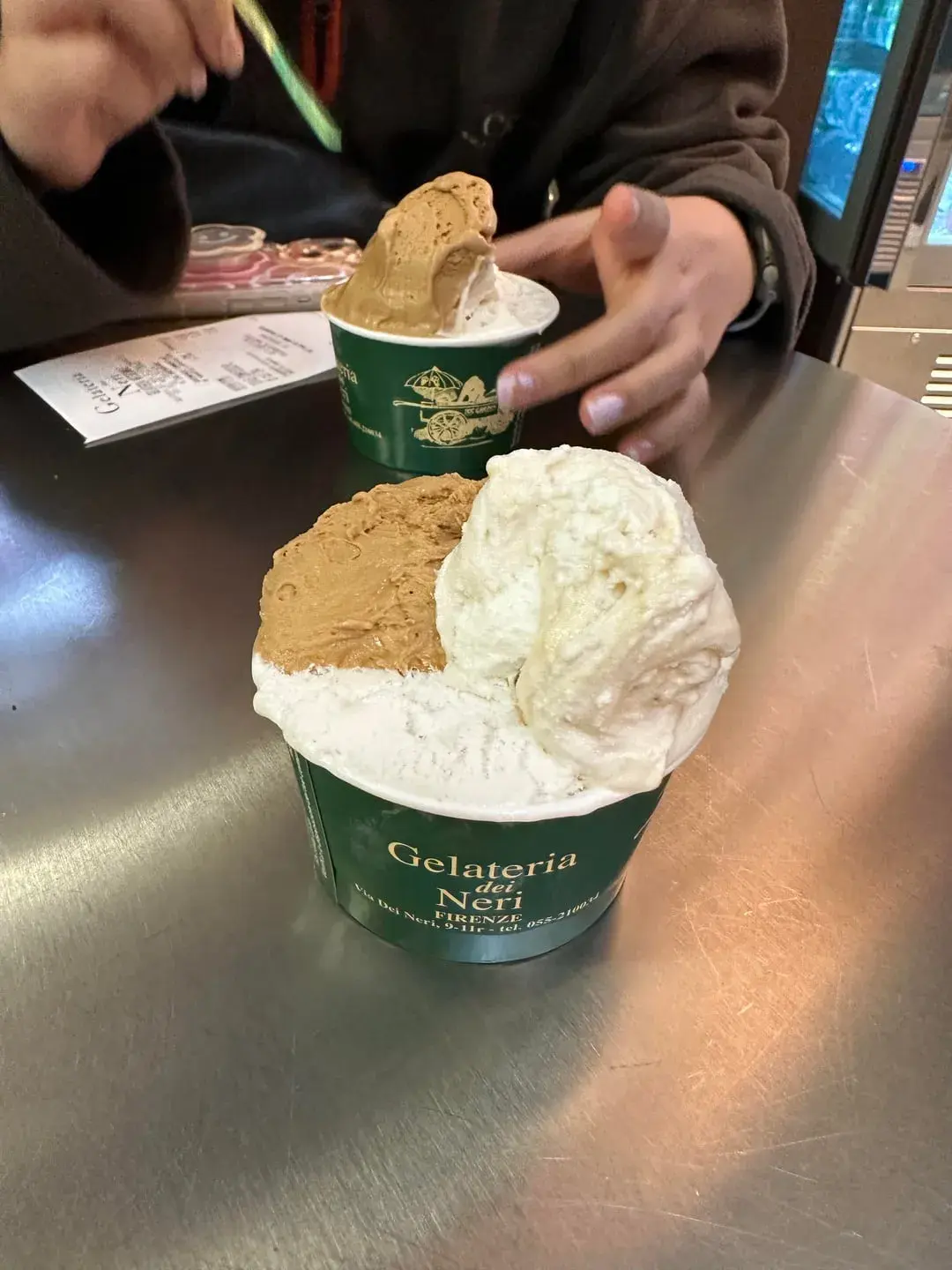
There’s a strong argument that Florence is gelato’s birthplace, and I’ve come to judge every shop by two signs: covered silver containers and low bins, both markers of authentic in-house gelato made without shortcuts. If the flavors are lit up in neon-bright colors, walk away; the real stuff sits in muted natural colors. My personal top picks include My Sugar, Gelateria Edoardo for a standout cinnamon flavor, Gelateria Della Passera, and Perché No!, the oldest gelateria in the city, dating to 1939.
If you want to go deeper, a gelato academy class will walk you through semifreddo, said to trace back to Catherine de Medici, and the hand-churned method that takes roughly 40 minutes compared with modern equipment. Try the banana semifreddo or an unexpectedly good tomato sorbet with olive oil and basil at Gelateria de’ Medici. Over in the Oltrarno, La Sorbettiera and Gelateria La Carraia both run family-friendly gelato-making classes, while Gelateria dei Neri near Santa Croce, plus Sbrino, Gelatificio Contadino, and Gelateria Artigianale La Sorbettiera, round out a proper gelato crawl.
Before you leave the topic entirely, track down the famous affogato at Vivoli — go at 9am to beat the line, order pistachio, and let a fresh espresso shot hit the scoop tableside. For coffee on its own terms, I keep going back to Coffee Mantra, Ditta Artigianale, Manly The Office, Cibrèo Caffè, Vintage Café, Cafe at The Hoxton, Simbiosi Organic Cafe, and PRAE.
Food Tours
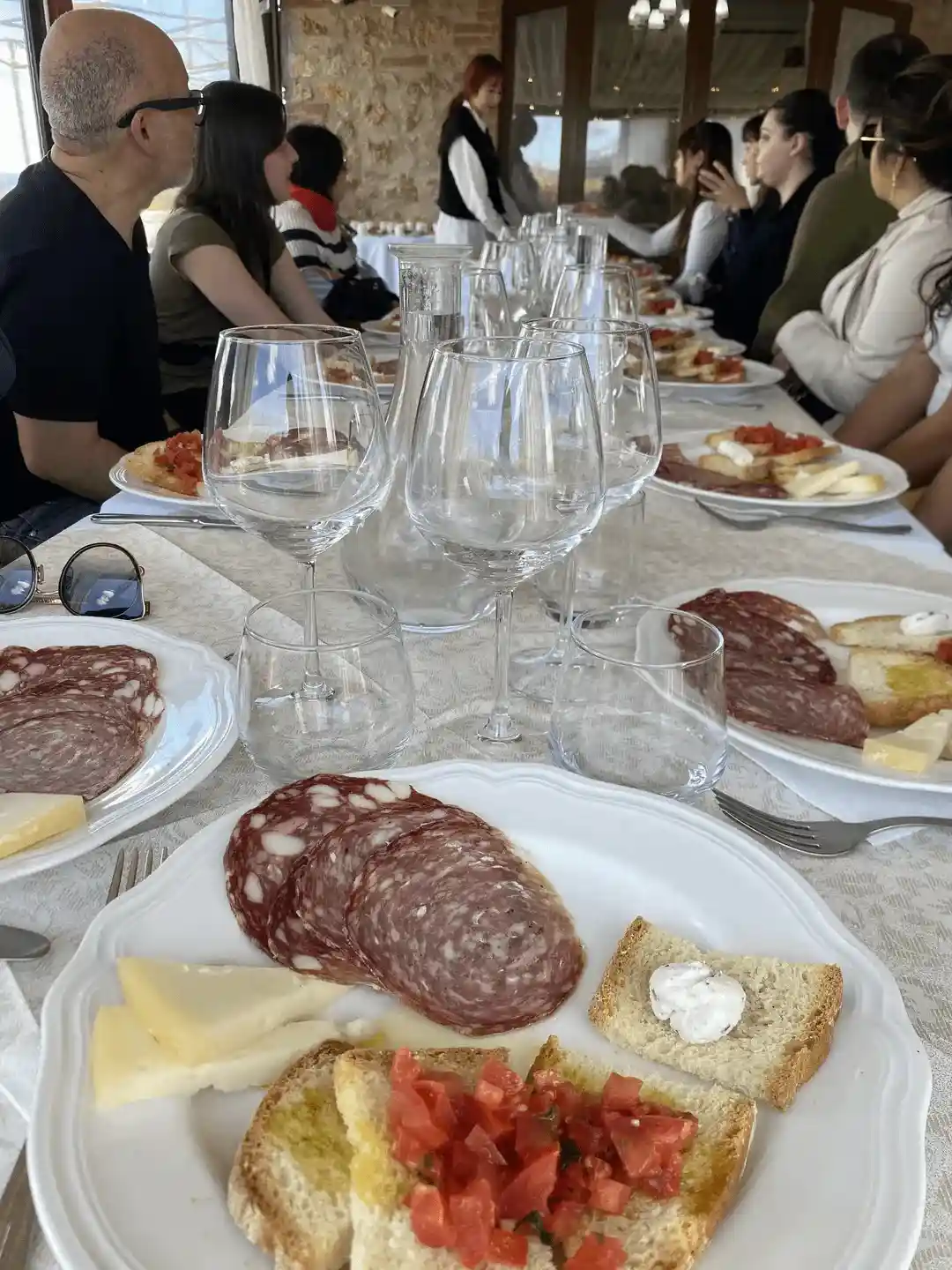
Book a food tour early in the trip — it’s the fastest way to learn the local dishes worth chasing for the rest of your stay. An evening food tour tends to give a broad sampling with solid restaurant recommendations along the way, often weaving through backstreets you’d never find alone. One route I loved started at Piazza della Signoria start, crossed the Ponte Vecchio crossing, and wound through pockets of street art and architecture before ending at a small farmers market in a quiet residential district, guided the whole way by a guide named Raffaela.
For something slower, a Sunday morning tour built around local authenticity runs 2-4 hours with multiple tastings beyond tourist areas. There’s also a dedicated sunset food tour through the Oltrarno hitting 5 stops, usually ending inside a proper trattoria for pecorino, gnudi, and a stop at a working historic wine window, finishing with a gelato finish — a full 3 hours that basically doubles as a full dinner.
If you’d rather cook than just eat, a Tuscan cooking class is worth the half-day. Most run as a hands-on class, either multi-dish or a focused single-dish class, covering everything from fresh pasta and tiramisu to ragu and Napoli-style pizza; some versions add pork and a glass of Chianti, taught with genuine Tuscan hill views through the kitchen window.
And because you can’t talk about Florence without talking about food, a quick primer: Tuscan cuisine, or Florentine cuisine, is hearty, ingredient-driven cooking built around a handful of icons. Bistecca alla fiorentina, a Chianina T-bone served properly rare or al sangue, runs roughly €45-60/kg and is meant for sharing. Street-level, look for a lampredotto tripe sandwich from one of the street carts, a bowl of ribollita (a bread-and-bean soup best in cooler months), schiacciata, a stuffed flatbread, or pappa al pomodoro, a comforting tomato-bread soup. For sit-down meals, Pizzeria Renato e Patrizia on Via dei Neri is proudly family-run since the 1970s, no-frills and cheap, with the added bonus of Piazza Santa Croce proximity; the Sant’Ambrogio area generally means better prices than the center. Mercato Centrale quick lunch and a Santo Spirito aperitivo are two easy wins on any itinerary. For proper dinners, I keep a running list: Vini e Vecchi Sapori for osteria classics, Dalla Lola for its daily-changing menu (a Stanley Tucci feature stop), Trattoria Sostanza for tableside butter chicken and a seasonal omelet, Cibrèo Trattoria for chicken meatballs and roasted pork, Il Latini for a genuinely hard reservation, Trattoria Da Ginone 1949 for gnudi, S.forno for a proper bakery and pantry staples, and Mister Pizza for a reliable no-reservation slice. For drinks, try Loggia Rooftop Bar for small plates and drinks with a view, or Rivoire for its famous hot chocolate. For panini spots, I rotate between Ino, Schiacciateria De’ Neri 18r, Pino’s, Trattoria Cammillo, Trattoria Sabatino, and Hostaria da Fulvio.
Bargello Museum (Museo Nazionale del Bargello)
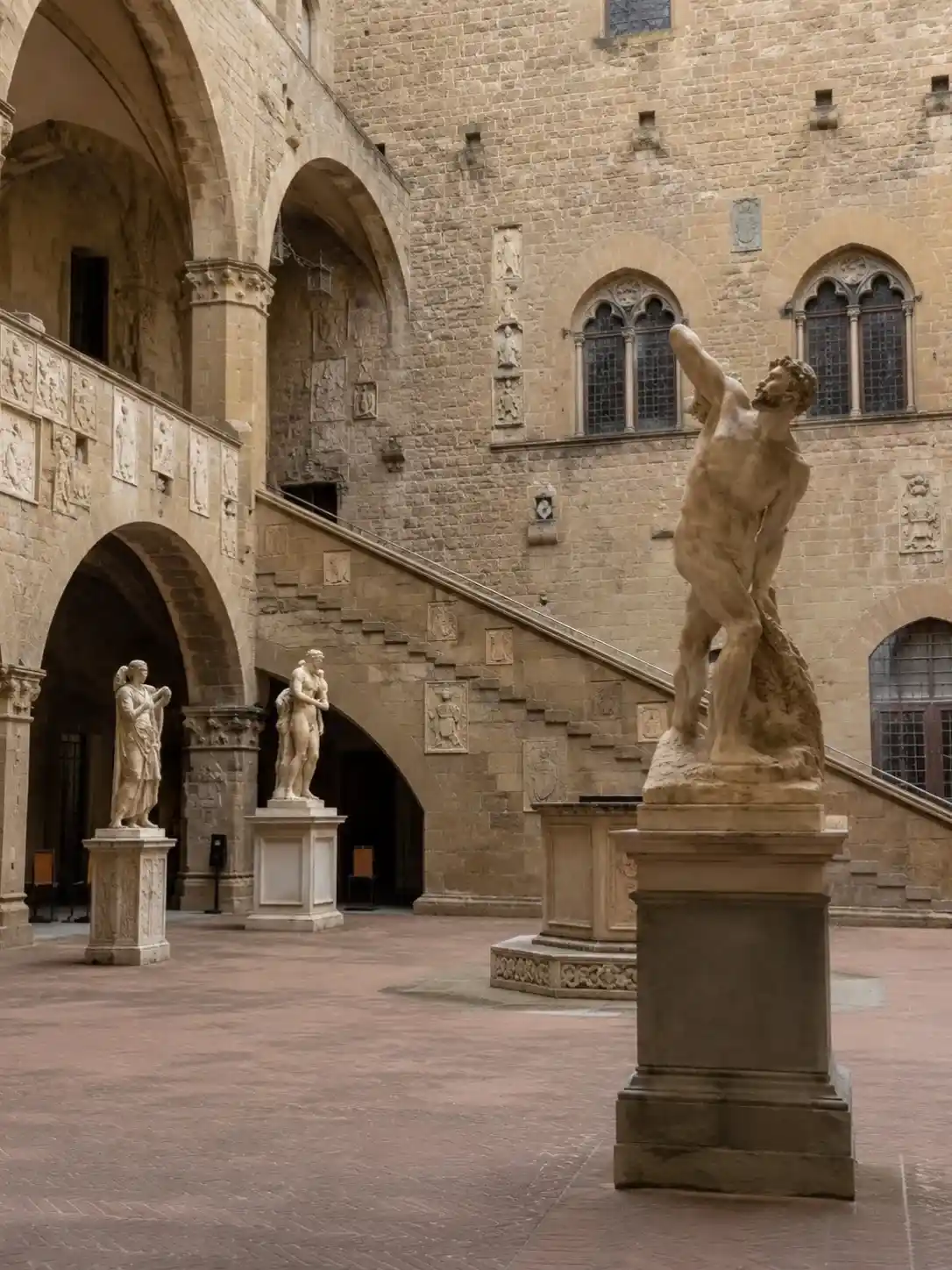
The Bargello Museum remains an elaborate art museum hiding in plain sight — a former prison that now holds a genuinely world-class sculpture collection, with Michelangelo and Donatello works that get a fraction of the Accademia’s crowds. It’s centrally located, less crowded, and honestly flying under the radar compared to its neighbors, which is exactly why it’s my favorite gem in the city. Grab a timed-entry ticket or a guided tour and set aside 1-2 hours.
Housed in the oldest public palace in Florence, dating to 1255 and once serving as the city prison, it now holds the single best Italian Renaissance sculpture collection in the country, including work by Cellini and the Della Robbia family. For a broader museum crawl beyond the obvious three, add Museo Sant’Orsola Firenze, a former convent turned rotating exhibit spaces with genuinely no crowds, or Palazzo Gucci, the brand’s flagship brand museum, complete with its own bag room.
Piazza della Repubblica (Carousel + Historic Cafés)
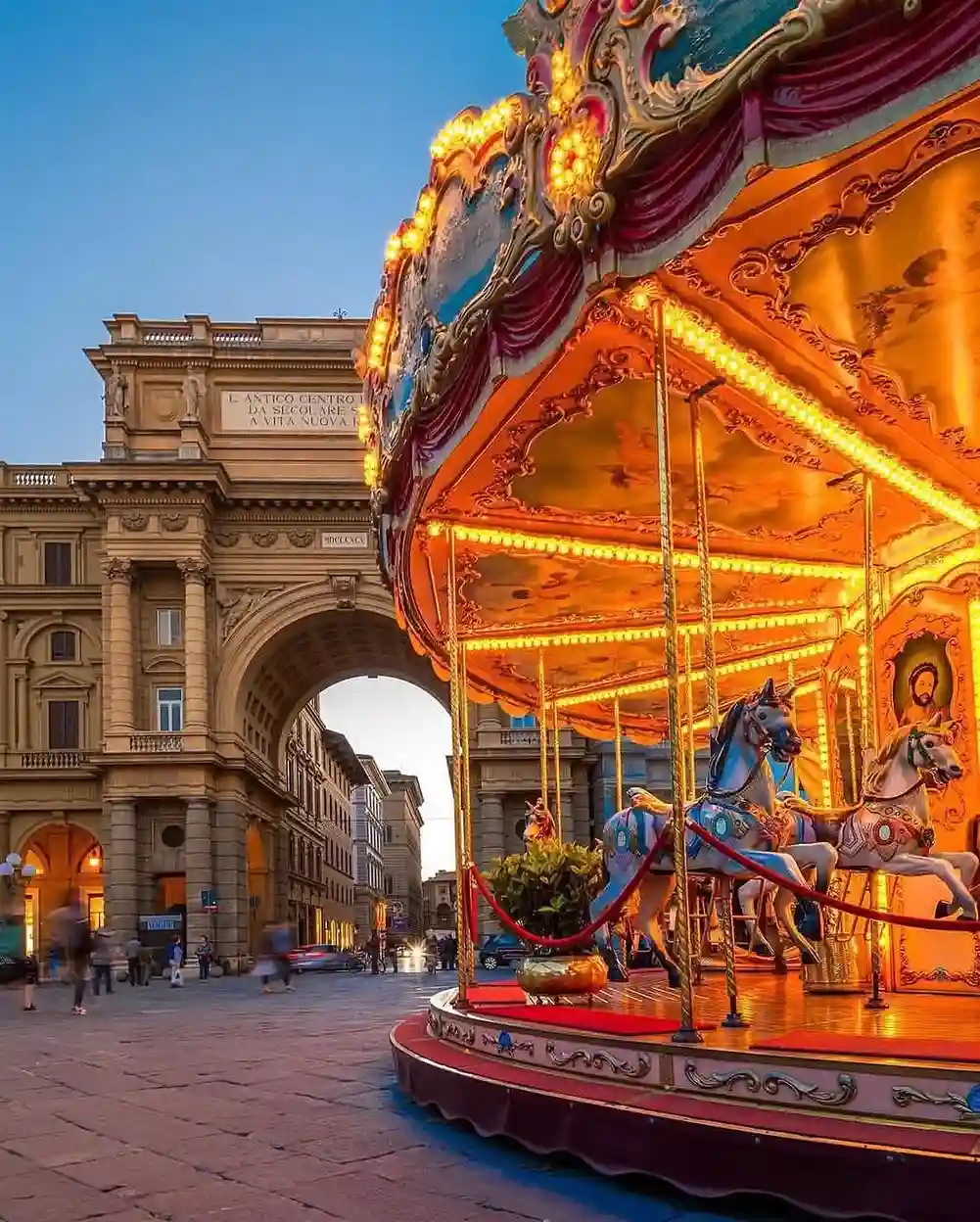
Piazza della Repubblica is the most-visited piazza for a reason — the beautiful architecture, resident buskers, and rows of souvenir stalls all orbit a genuinely charming antique carousel offering affordable rides for a few euros; my son’s actual first carousel ride happened right here. Above it all, the Rinascente department store hides a rooftop bar with a surprisingly good Duomo view, though be warned the square itself gets very crowded by midday.
Built in late 19th century on the site of the old Roman forum and later a medieval market, this stretch traces back to ancient Florentia itself, marked by the Arcone triumphal arch. Historic cafés Caffè Gilli, open since 1733, and Caffè Paszkowski are both pricier stops but worth it once, especially for younger children entertained by the evening street performers. It remains an elegant square ringed with cafés and restaurants, officially built 1895.
Porcellino Statue (Mercato Nuovo)
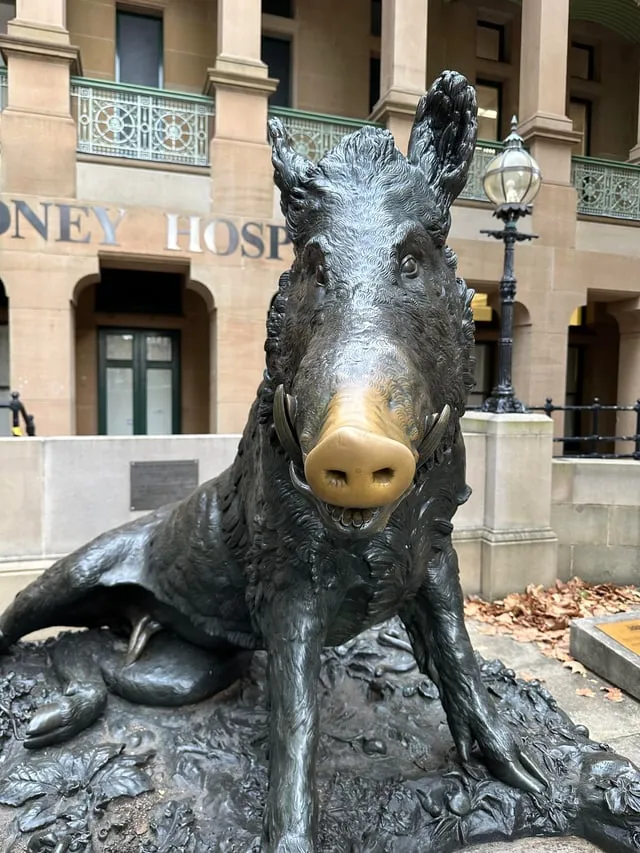
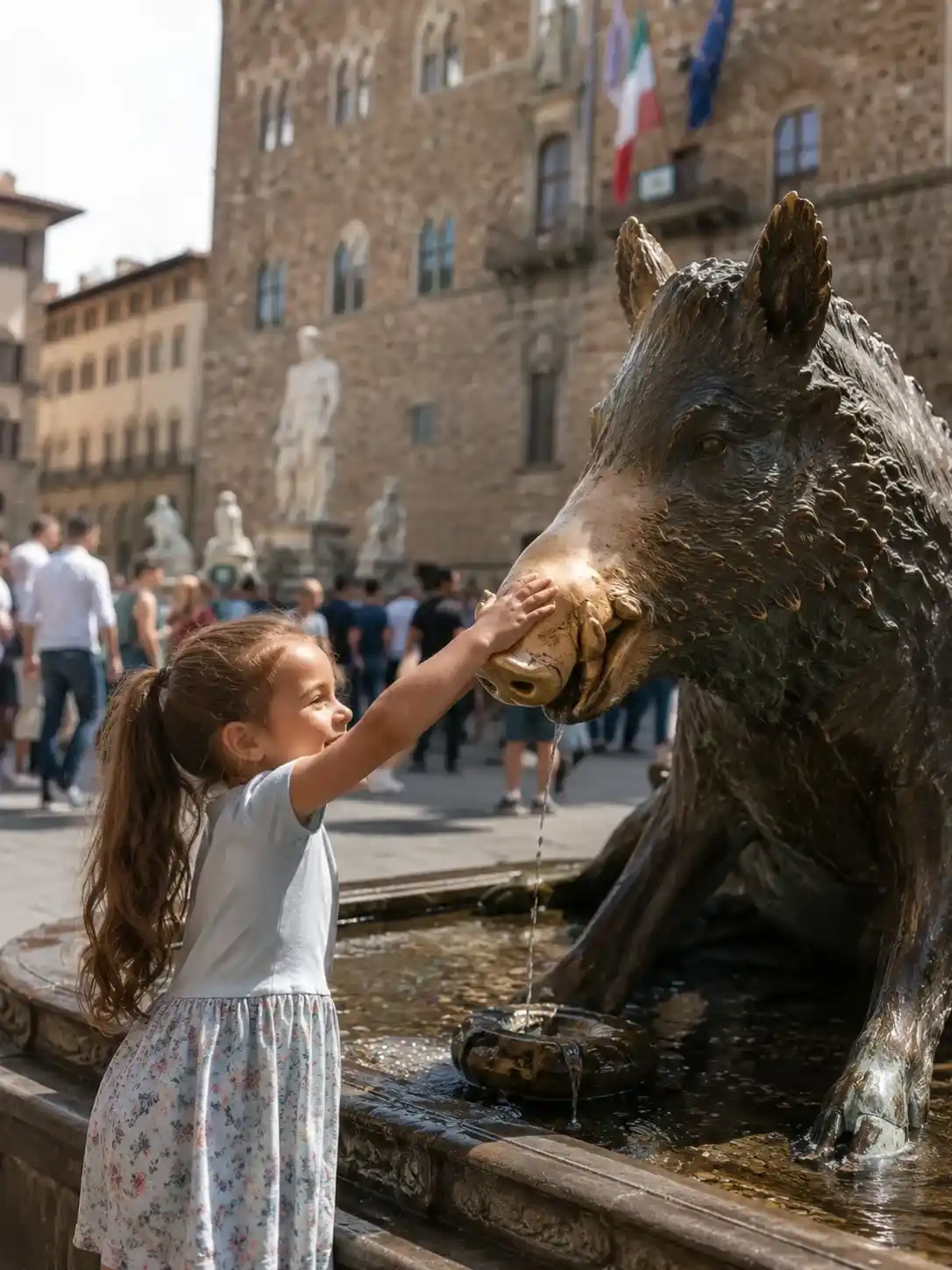
I genuinely didn’t expect to love the Porcellino Statue as much as I do, but there’s something charming about the bronze wild boar statue sitting inside the open-air Mercato Nuovo. The tradition of rubbing nose and sliding a coin through grate for good luck and a promised return trip never gets old, even though the statue itself is a replica statue — the 17th-century original now lives safely inside the Bardini Museum, with replicas elsewhere as far off as Savannah GA and New York City.
It’s a small tradition, but it’s kids popular, and the ritual snout rub makes for an easy photo stop. We literally stumbled on fountain on our first walk through the city thanks to some friendly local encouragement, and the coin drop has become something of a running joke on repeat visits — always a solid one when you’ve got kids and need something hit with kids between bigger sights.
Walking Tours of the Historic Centre
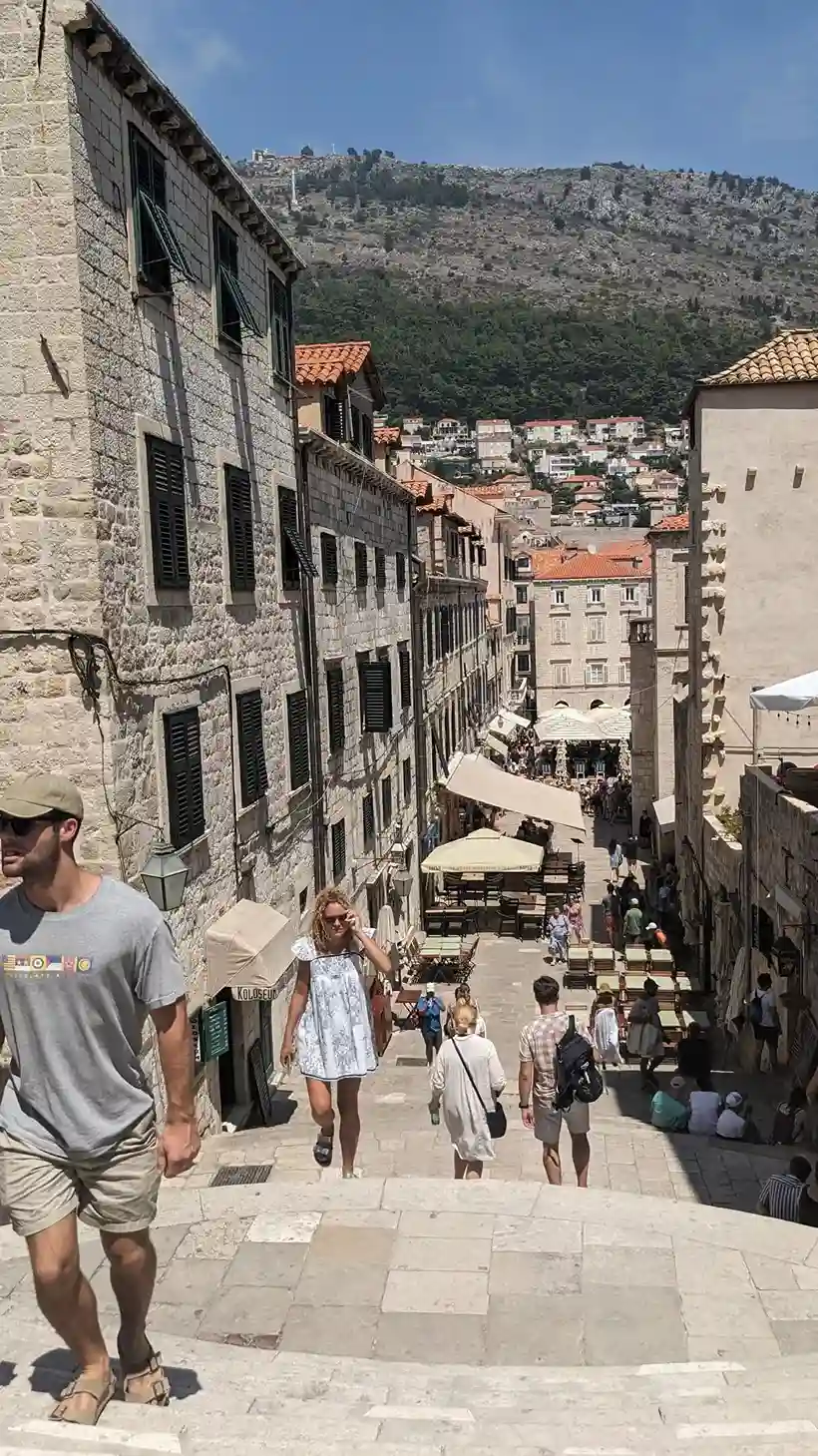
If you only book one thing before landing, make it a proper walking tour. Guided walking tours offer genuinely efficient sightseeing, and a David and Duomo climb combo solves half your logistics in one morning. Even an affordable general tour with no attraction entries included is worth it as a day one recommendation for independent travelers, since a good guide will explain Medici politics and Savonarola’s bonfires far better than any plaque ever could — right down to the pietra serena paving stone underfoot.
Most run 2-3 hours, and I’d steer toward small-group tours or private tours over the large rushed groups you’ll see shuffling through at pace. If budget or timing rules that out, a self-guided walk through the Centro Storico hitting Piazza del Duomo, the Medici Chapels, Piazza della Signoria, Piazza della Repubblica, and Ponte Vecchio works almost as well with an early start to avoid crowds.
Palazzo Strozzi (Contemporary Art)
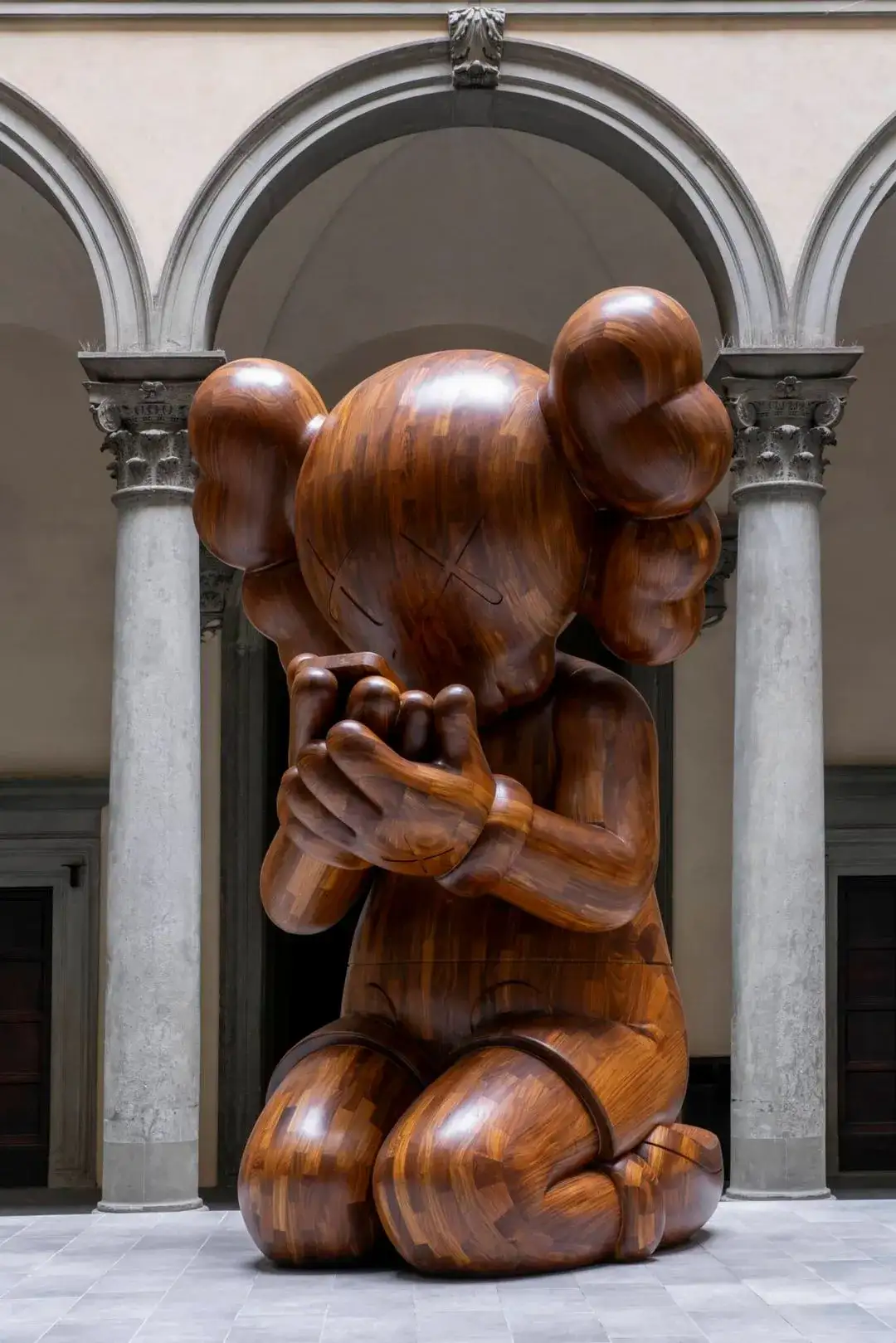
Palazzo Strozzi is where I send anyone who needs a break from the Renaissance for an afternoon. It runs consistently strong major temporary exhibitions covering modern art and contemporary art inside a genuinely grand 15th-century palace, offering a welcome change of pace from wall-to-wall Renaissance frescoes elsewhere in the city. The free-to-enter courtyard alone is worth a stop even if you skip the rotating exhibitions, though it’s worth doing a quick check website first since the program changes often.
Built by the Strozzi family in the late 1400s, it’s considered one of the finest civil-Renaissance palaces in Florence, with striking rusticated stonework and a genuinely grand grand courtyard at its center — a rare spot doing both historical and contemporary art justice under one roof.
Nearby, tuck in a stop at Giunti Odeon, a combined Libreria e Cinema — part bookstore, part library, part working cinema with a small balcony that hosts 9pm screenings for an unexpected movie night. A short walk away, the Orto Botanico Giardino dei Semplici is a genuine botanical garden run by the university — a peaceful, often visitor-free mix of indoor outdoor spaces that most guidebooks skip entirely. And for something purely fun, find a film photobooth, specifically Fotoautomatica, one of the last machines using real black-and-white film; there are five locations around the city, they take coins, there’s a 3-second delay, and it takes about 4 minutes to develop — a genuinely great, low-tech souvenir.
If shopping is more your speed, budget time in the Oltrarno for genuinely independent finds: Lucaworkshop and Giuliano Ricchi Jewelry for hand-made charms behind a deliberately hidden entrance you access by ringing a doorbell; Grocery Pirgher Marzio for cheese charcuterie; Momo Vintage and Recollection by Albrici for vintage designer bags, silks, and dresses; Castorina 1895 for hand-carved wood; Monica Miato for handmade bags and textiles; and La Casa Della Stampa Di Sarubbi Lorenzo for vintage prints and maps. For broader vintage shopping alongside the big Italian design houses like Gucci and Versace, add Street Doing Vintage Couture, Giratempo Vintage Store Firenze, and Epoca Vintage Firenze to the list.
Where to Stay in Florence
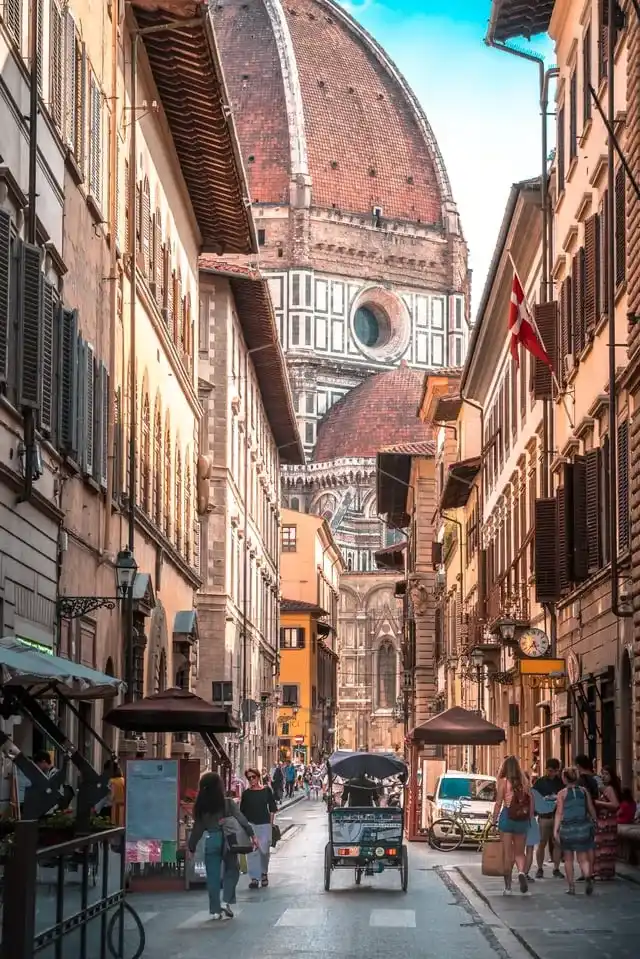
For centrally located hotels with easy reach to top attractions, the area around Santa Maria Novella train station offers walking distance to Duomo without the premium of being directly on the square. On a budget, Hotel Dali is a genuine 1-minute walk from the sights, though it has no A/C, which matters more than you’d expect in July. A step up, Hotel Silla is solid mid-range option near the Arno, quiet, with included breakfast that actually delivers. For a splurge, Hotel Lungarno is proper luxury, sitting Arno-front with genuine Ponte Vecchio views from some rooms.
I generally think in terms of six base-area profiles. The Duomo historic centre is the most convenient but also the busiest and priciest, best for first-timers on short stays who want everything well-connected. Along the river, you get strong transport links, good value, and a genuine local feel, plus good restaurants that draw foodies and couples. The Oltrarno quieter, more artisan side of the river suits families and repeat visitors looking for something less scripted. San Lorenzo affordable options exist but can run noisy, better suited to budget travelers and market lovers than light sleepers. Further out, Fiesole offers genuine countryside views and a relaxed pace for longer stays, ideally with a car. All of this sits around the same handful of core neighborhoods — Centro Storico, Oltrarno, and Santa Croce — and a short list of properties worth knowing: Plaza Hotel Lucchesi, La Maison du Sage, Residenza La Musa Amarcord, Casa Così, Pietrapiana 34, Hotel Number Nine, The Artists’ Palace Florence, Casa G. Firenze for Duomo-view apartments, Hotel Palazzo Guadagni, AdAstra Suites, and SoprArno Suites in Santo Spirito for Palazzo Pitti-facing apartments.
A quick set of Florence quick facts while you’re planning: this is the Tuscany regional capital, served by Florence Airport, just 5km out (locally the FLR airport, about 15 minutes from downtown), with a Pisa Airport transfer running closer to 80 minutes. High-speed trains connect easily, with Rome 1.5 hrs, Venice 2 hrs, and Milan 1 hr 40 away, arriving into Santa Maria Novella station near the train station. The currency is the Euro, the language is Italian, and English widely spoken makes daily logistics easy. On getting around, walking wins for most of the historic core, supplemented by Lime scooters, ATAF buses, trams, or Uber and taxis when it’s raining — though both can be hard to secure at peak times, so private transfers are worth booking ahead. If you’re driving in, know the car ZTL fine warning cold: fines 3-36 months later are common for tourists who didn’t realize the historic center is restricted, so plan any rental car pickup for the edge of town and stick to train station drop-off if you’re returning it. Practically, sort out cash card guidance before you land, grab an eSIM, and download offline maps — small things that save real time once you’re here.
Away from the postcard shots, the Oltrarno district rewards a slower afternoon: it’s genuinely less touristy, with a lived-in atmosphere, real artisan workshops, and independent cafés that don’t cater to tour groups. Santo Spirito square runs a low-key morning market and a solid aperitivo scene by evening, anchored by a modest, Brunelleschi-designed church on the square. Just off it, Piazza della Passera is a genuinely hidden square worth finding on your own rather than following a map pin.
How many days do you need in Florence?
Two full days covers the main highlights — the Duomo, Uffizi, Accademia, and Ponte Vecchio — comfortably, with an evening at Piazzale Michelangelo worked in. If you can stretch to three to four days, add the Oltrarno, Pitti Palace, Boboli Gardens, a proper food tour, and room for one day trip out of the city.
Is Florence walkable?
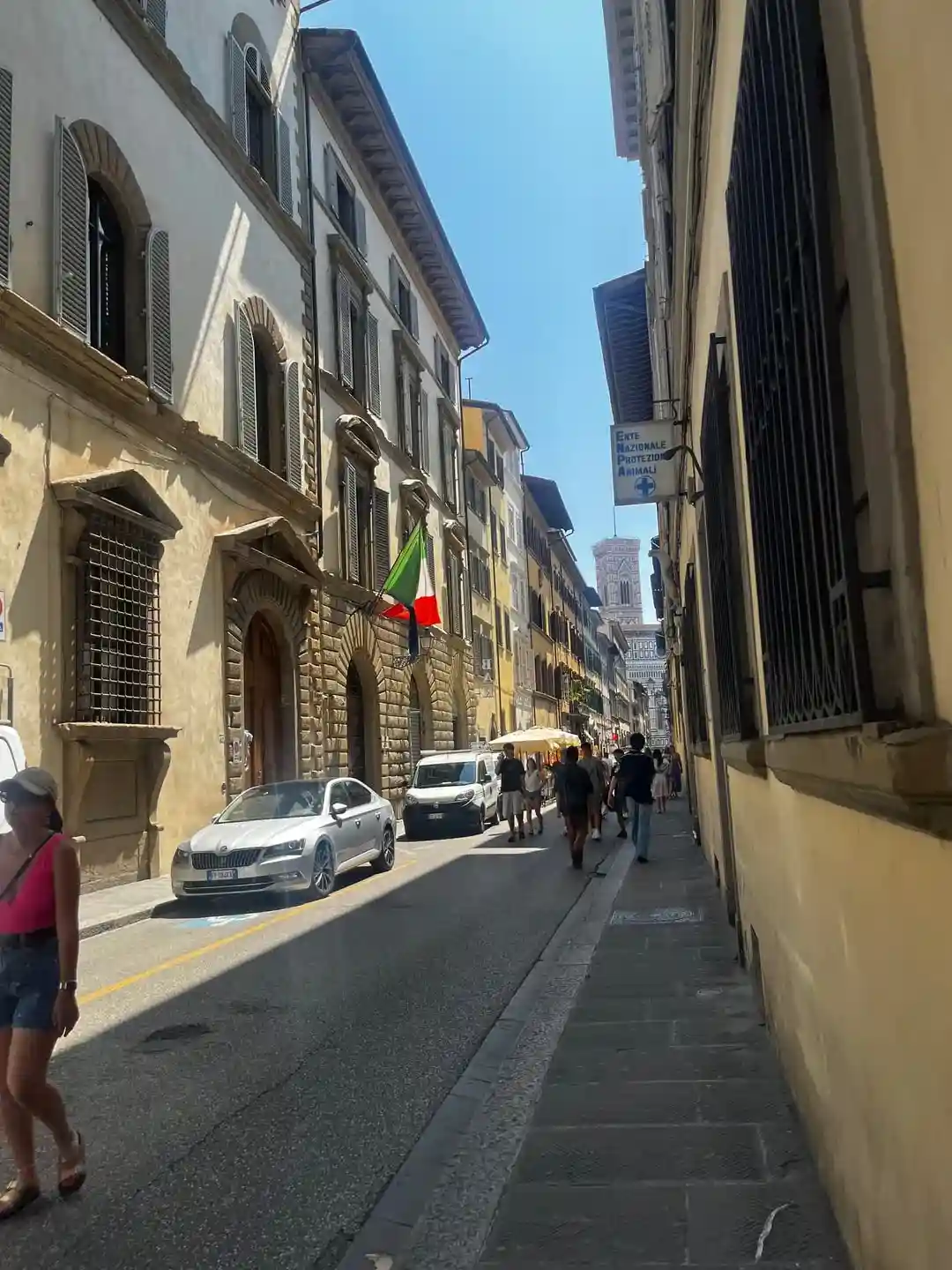
Yes — genuinely, remarkably very walkable. The historic centre is compact and largely pedestrianized, and from the train station it’s typically about a 15-minute walk to Ponte Vecchio, with most major sights clustered tightly enough that you’ll rarely need transport at all.
What is the best time to visit Florence?
April-June and September-October bring the sweet spot of pleasant weather and genuinely manageable crowds. July-August turns hot, regularly pushing 35°C, and gets very busy to match; winter is quieter and cheaper, though expect reduced hours at some sights. For Florence planning tips, know that peak season runs roughly mid-April to October, with quieter October and early spring as smart in-between windows — just watch out for Easter week, when everything spikes regardless of the calendar. Florence genuinely has four seasons worth planning around: hot humid summers versus milder spring fall, and most seasoned visitors settle on a three full days trip length as the sweet spot between seeing enough and burning out.
Do I need to book museum tickets in advance?
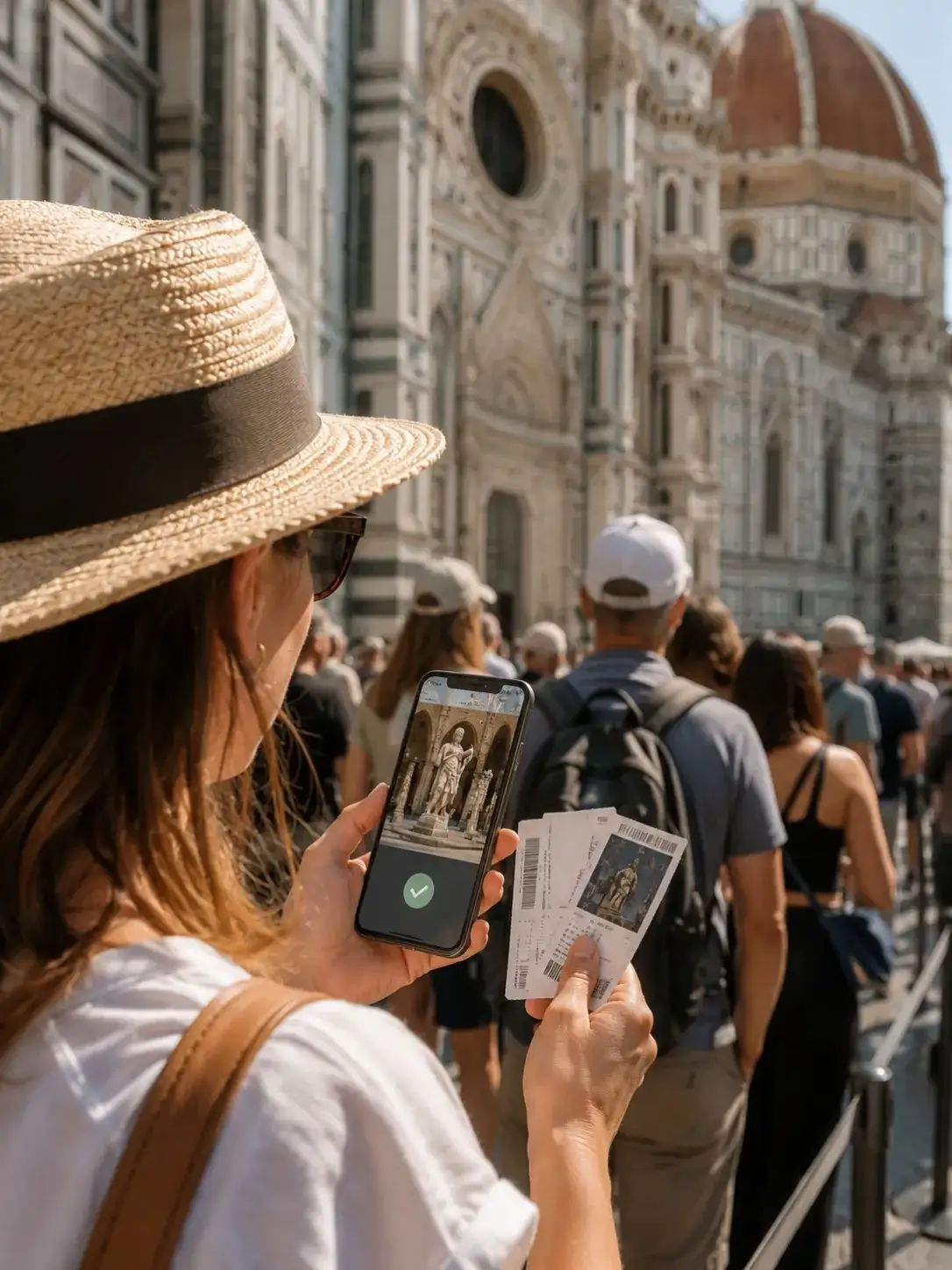
Yes, without question, for Uffizi, Accademia, and the Duomo dome climb — all three regularly sell out weeks ahead in peak season, so book early through official sites to actually secure availability. It’s worth pairing that habit with a bit of general planning: book attractions ahead, respect the church dress rules everywhere you go, watch belongings in crowded queues, and book restaurants in advance if you have a specific place in mind for dinner. On safety, a few honest safety notes: Florence is generally safe, though there’s a real pickpocketing risk in crowded tourist zones, so ordinary city awareness goes a long way.
Is Florence good for kids?
Florence is more walkable, more forgiving, and more fun for families than people expect. Beyond gelato everywhere, look for interactive family tours, the Uffizi treasure hunts, and open piazzas where kids can genuinely burn off energy between museum stops.
For something more structured, the Uffizi Treasure Hunt is guide-led with a map and a questionnaire offering small prizes, all built around Medici family stories that keep even reluctant kids engaged. A hands-on gelato-making class works well too, as does the Leonardo da Vinci Interactive Museum, full of wooden inventions suited to ages 5+ and priced around €10 to €8. Palazzo Vecchio children’s tours cover the building’s secret passageways through the lens of Renaissance childhood, and the Stibbert Museum, with its serious armor and weapons collection inside an actual villa and parkland, reliably delivers on castles and knights for anyone under ten. Round it out with the easy wins — the Il Porcellino nose rub, a spin on the antique carousel, pizza by the slice, the free statues around town, and the slightly castle-like setting of the Bargello. My honest rule with kids is one major stop per day, padded generously with gelato breaks, piazza breaks, kid-friendly food tours for kids, and plenty of open green space to run around in.
How much do Florence’s main attractions cost?
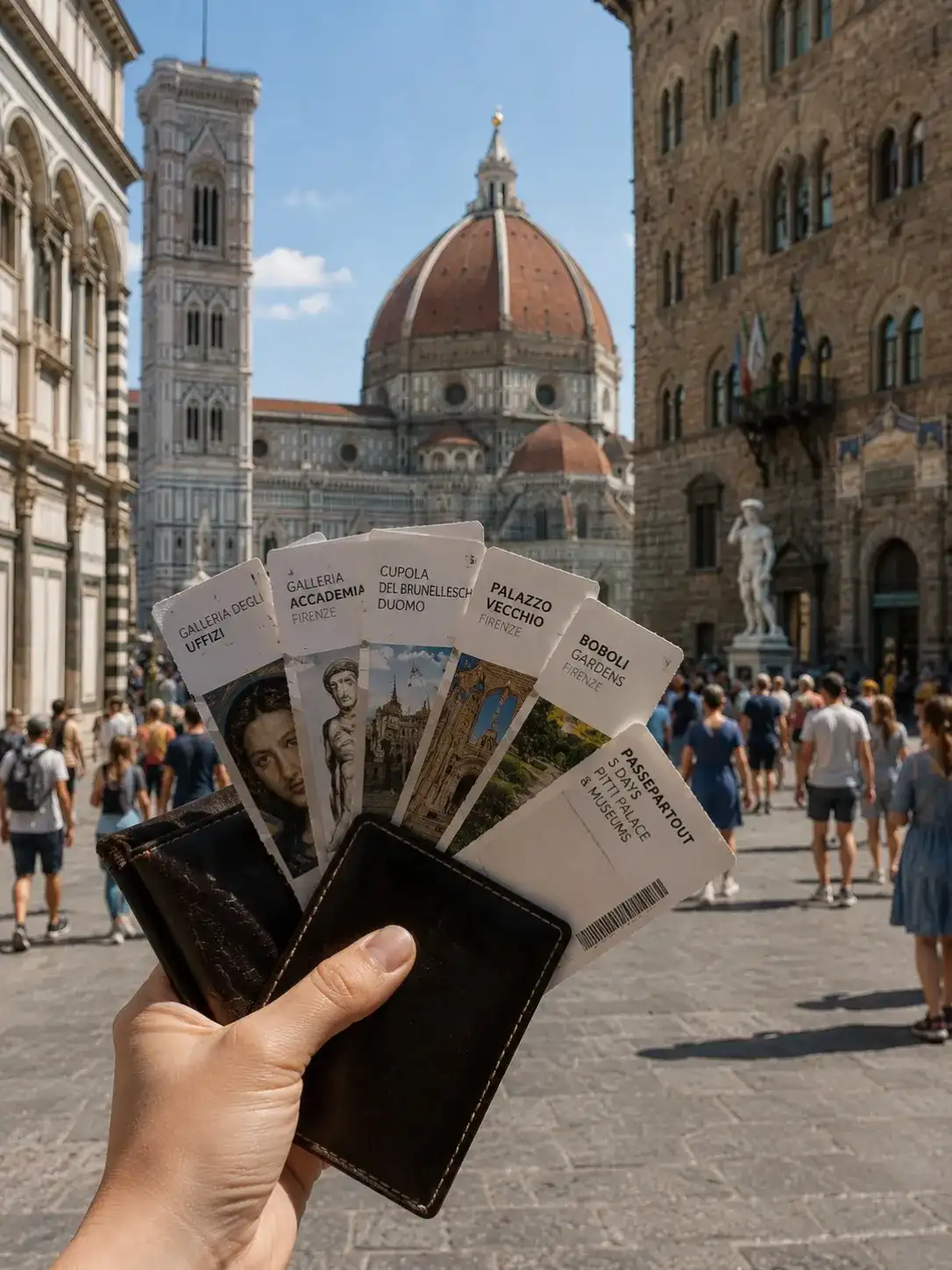
Rough 2026 pricing: Uffizi €25-29, Accademia €16, Duomo dome climb €30 (or the Brunelleschi Pass), Palazzo Vecchio €19, Boboli Gardens €10-13, with the cathedral free to enter and a 5-day Passepartout covering Pitti for €40. For genuine money-saving tips: the free cathedral, free piazza sculptures, free Loggia, free Ponte Vecchio, and several free churches cost nothing at all, the Uffizi afternoon discount is real, and the first Sunday of month free entry is worth building a trip around if your dates allow — just expect heavy crowds that day, so treat any of this as advance-booking guidance rather than a same-day plan.
Can you do Florence as a day trip?
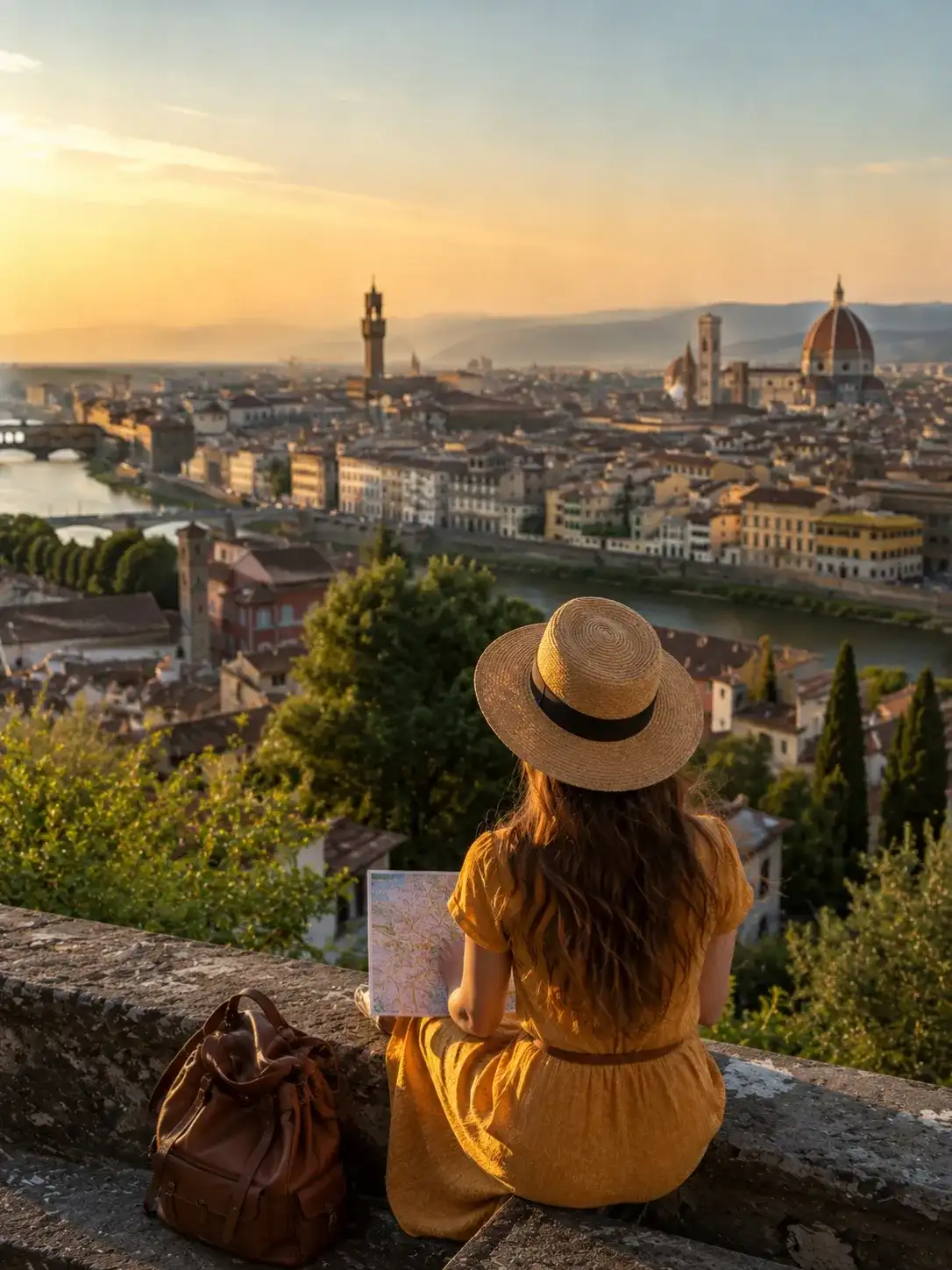
The highlights are technically doable in a day if you commit to pre-booked tickets and a tight planned route, but I’d still push for staying overnight, even one night, since once the tour groups leave, the piazzas at night take on a completely different character — quieter, warmer, more like a city that actually lives there rather than one on display, and the evening hours alone are worth the extra hotel cost.
Florence also makes a brilliant base for its own day trips. Siena, a medieval Etruscan-rooted city, is roughly 55 minutes away by train or Itabus, worth it alone for the Duomo Piccolomini Library, the Torre del Mangia, and Piazza del Campo. San Gimignano, the classic hilltop village, is about a 1.5 hour bus ride, home to the Duomo di San Gimignano and a climb up the Torre Grossa. For wine lovers, the Chianti wine region is best covered by rental car or a driver-led tour through Greve and Radda, often paired with local cooking classes. Further afield, the Val d’Orcia towns, Lucca, and even Cinque Terre are all realistic if you’re willing to make it a longer day.
Finally, a note on atmosphere that’s easy to forget while ticking off a list: the real joy of this city is simply to explore the old town, strolling without a fixed plan through the historic center as if it were one continuous open-air museum. Stop on any street corner, listen to the music drifting from street performers and wandering musicians, and stay out past the sunset emergence into the late nights — that lingering atmosphere is, in the end, the thing I remember most clearly from every single trip back.